
Aayushma Mehta - Author
2026-03-26
The exams are finally over. You’ve stepped out of the hall, leaving behind the long hours of preparation, late-night revisions, and endless mock tests. The pressure that once filled your classroom is gone, replaced by a sense of relief but also a quiet uncertainty.
In Nepal, the SEE (Secondary Education Examination) is often treated as the most important exam of a student's life. It feels like a gatekeeper. If you don't get the marks you want, it feels like the door to your future is closing.
But here is a secret that top students and career counselors know: The smartest way to prepare for SEE is to know what comes next.
When all your focus is only on exams, the pressure builds up, and your books start to feel like a burden you just need to finish. But now that your SEE exams are over, things feel different. You finally have time to pause but along with that comes a new set of questions: What are you going to do after SEE? Will you just waste the gap period, or use it to learn something productive?
This is the moment where your perspective can shift. Instead of seeing your past studies as pressure, you can start seeing them as a stepping stone toward your future. If you’re a student in Nepal who has just completed SEE, you don’t need to wait for the result day to take action. In fact, using this gap period wisely can give you a head start and help you build skills that actually matter for your future.
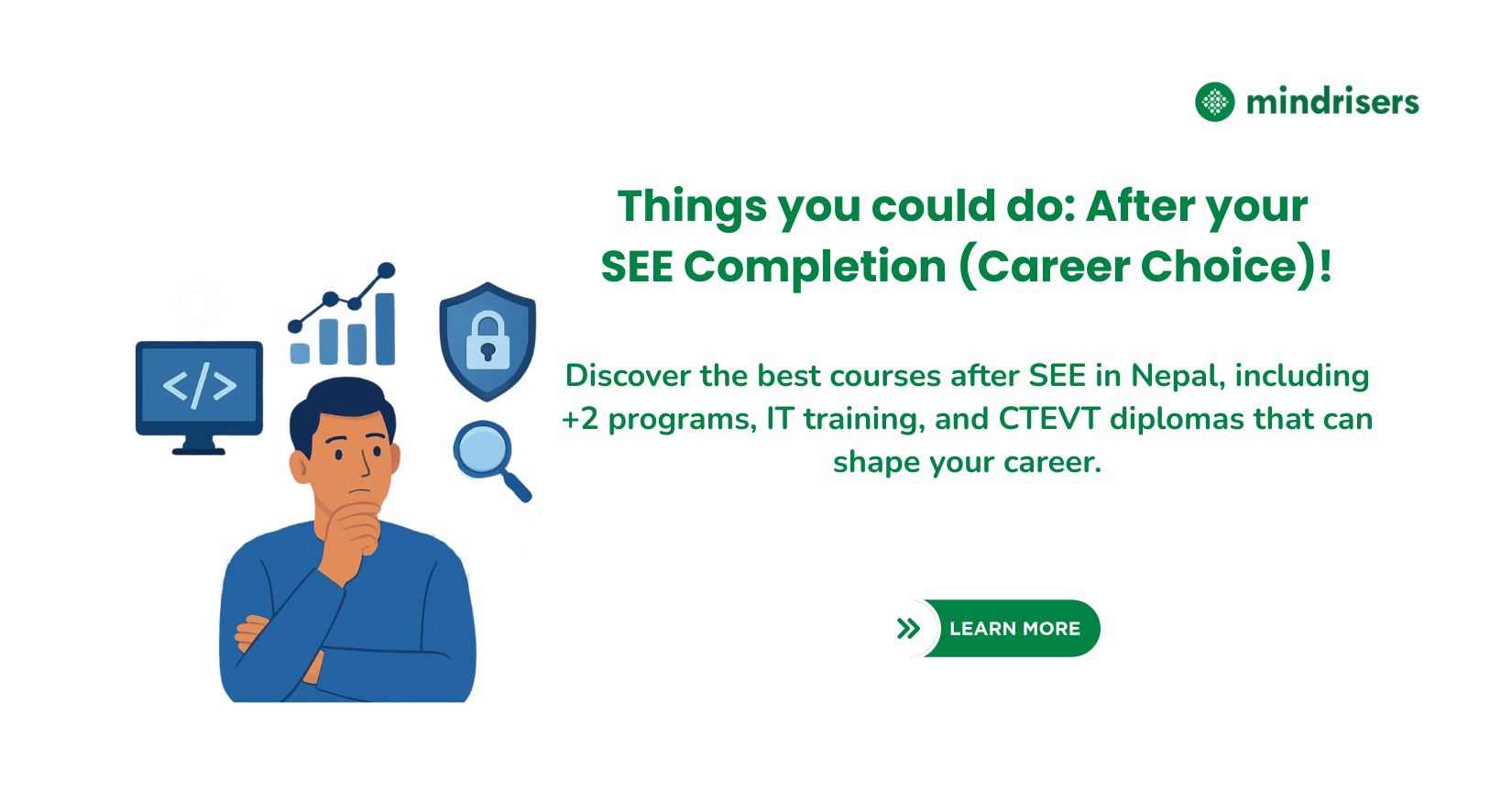
In this comprehensive guide, we will explore the best courses after SEE in Nepal, how to choose the right stream, and how you can align your current studies with your long-term goals.
Why Plan Your Career Before the SEE Result?
Waiting until the result day to decide can lead to rushed choices, wrong stream selections, and missed admission deadlines. By researching now, while you are still in the thick of your SEE prep, you gain a strategic advantage.
Here is why early planning matters:
- Reduce Anxiety: Knowing you have options makes the exam feel less like a life-or-death situation. If you know you have a backup plan (like a CTEVT diploma or an IT foundation course), the pressure to get a perfect GPA reduces.
- Save Time: Admission processes in Nepal can be lengthy. You can prepare documents, research institutes, and even visit campuses while you study. This ensures you are ready to apply the moment the result is out.
- Align Skills: You can choose subjects in SEE that give you an advantage in your future course. For example, if you know you want to do Engineering, focusing on Math and Science now is crucial. If you want to do Management, English and Social Studies become your priority.
- Scholarship Opportunities: Many institutes offer scholarships based on SEE performance. Knowing the requirements early helps you aim for the right cutoff.
The 3 Major Pathways After SEE
While you are studying for your SEE, keep these three main paths in mind. Each requires a different strategy and offers different career outcomes.
1. The Academic Route: +2 (Higher Secondary)
This is the most common path in Nepal. If you are aiming for a traditional university degree (like BSc, BBS, BA, or BEd), you will likely choose Science, Management, or Arts for +2.
- Best for: Students who want to keep all university doors open and are interested in academic research or professional degrees like Medicine, Engineering, or Law.
- Top Colleges: St. Xavier’s, Padma Kanya, St. Mary’s, and government colleges like Tri-Chandra.
- SEE Focus: Ensure you score well in Math and English, as these are crucial for +2 admission in top colleges. A GPA of 3.5+ is often required for competitive streams like Management and Science.
- University Path: After +2, you can apply to Tribhuvan University (TU), Kathmandu University (KU), or Purbanchal University (PU).
2. The Tech & Innovation Route: IT & Computer Science
This is where the future is heading. In Nepal, the demand for skilled IT professionals is skyrocketing. With the rise of startups, digital banks, and remote work, IT skills are becoming the most valuable currency for young Nepalis.
- Why choose this? High salary potential, remote work opportunities (freelancing), and global demand.
- Skills to Look For: Web Development, App Development, Networking, Cyber Security, and Data Analysis.
- Mindrisers Insight: At Mindrisers Institute of Technology, we believe that technology is the language of the future. Whether you choose a Diploma in IT or a specialized course, having technical skills gives you a competitive edge over traditional graduates.
- Career Scope: Software Engineer, System Administrator, Digital Marketer, or Freelancer.
3. The Technical Route: CTEVT & Diplomas
If you prefer hands-on learning over theory, Technical and Vocational Education and Training (TVET) is a fantastic option. The Council for Technical Education and Vocational Training (CTEVT) offers diplomas that lead to direct employment, often faster than a 4-year degree.
- Why choose this? It is cost-effective, practical, and highly respected in the job market.
- Popular Courses:
- Diploma in Nursing (DHN): High demand in Nepal and the Middle East.
- Diploma in Civil/Computer Engineering: A direct path to the engineering sector.
- Hotel Management & Tourism: Perfect for Nepal's booming tourism industry.
- Agriculture & Forestry: Great for sustainable farming and environmental science.
- Note: After completing a CTEVT diploma, you can often join the 2nd year of a Bachelor's degree in Engineering (IOE) or other fields, giving you a head start.
How to Choose the Right Course for You?
While you are solving math problems or memorizing history dates, take a moment to ask yourself these critical questions. Your answers will guide your career path.
- Do I like solving problems?
- If Yes: You might enjoy Science, Engineering, or IT. These fields require logic and analytical thinking.
- Do I like creating things?
- If Yes: You might enjoy Design, IT (Development), or Arts. This includes graphic design, coding, or architecture.
- Do I like managing people?
- If Yes: You might enjoy Management, Commerce, or Hospitality. This involves leadership, communication, and organization.
If you lean towards technology, consider looking into IT courses after SEE. Institutes like Mindrisers Institute of Technology offer specialized programs designed to bridge the gap between SEE and professional IT careers.
Balancing SEE Prep with Career Research
You might be thinking, "I don't have time to research careers while studying for SEE! I need to focus on my mock exams!"
You don't need hours. Just 15 minutes a day is enough. Here is a practical strategy to balance both:
- Weekend Research: Spend one hour on the weekend browsing course requirements. Look at college websites and admission brochures.
- Talk to Mentors: Ask your teachers or seniors about their career paths. They can tell you what was hard and what was easy.
- Visit Institutes: If you are in Kathmandu or nearby, visit campuses like Mindrisers Institute of Technology to understand the environment. Seeing the labs and classrooms can help you decide if you like the setting.
- Use Study Breaks: Instead of scrolling social media, read about career trends on LinkedIn or educational blogs.
A Practical Path into the Tech Industry
If you decide that IT is your passion, you need an institute that understands the industry. Mindrisers Institute of Technology is committed to providing practical, industry-relevant education that goes beyond textbooks.
Here is why students choose us for their post-SEE journey:
- Hands-on Training: We don't just teach theory; we teach you how to build. Our labs are equipped with modern hardware and software to ensure you get practical experience.
- Career Support: We help you find internships and jobs after your course. We connect you with industry partners who are hiring fresh talent.
- Flexible Learning: We understand that students have different learning speeds. Our curriculum is designed to be engaging and accessible.
- Industry-Aligned Curriculum: We update our courses regularly to match the current market needs in Nepal and abroad.
Your SEE is Just the Beginning
The SEE examination is a milestone, not the finish line. It is a test of your discipline, but it is not a test of your worth. Whether you choose to pursue a Diploma after SEE, join a +2 program, or dive straight into IT skills, the most important thing is to keep moving forward.
Don't let the fear of the unknown stop you. Use this preparation time to build a roadmap for your success. The world is changing, and the skills you build today will define your tomorrow.
Ready to explore your options? Visit Mindrisers Institute of Technology today to learn more about our foundation courses and how we can help you build a career in technology.
Frequently Asked Questions (FAQs)
Q: Can I join an IT course immediately after SEE?
A: Yes, many institutes, including Mindrisers Institute of Technology, offer foundation and diploma courses in IT that accept SEE graduates. You do not always need +2 to start learning tech skills.
Q: Is it better to do +2 or a Diploma after SEE?
A: It depends on your career goal. +2 is better for university degrees (like BSc or BBS), while a Diploma is better for practical skills and faster job entry.
Q: How do I prepare for SEE while planning my career?
A: Focus on your studies first, but dedicate 15 minutes daily to researching career options. This keeps you motivated and reduces last-minute stress.
Q: Does Mindrisers offer counseling for SEE students?
A: Yes, we provide career counseling to help students choose the right path after SEE. We help you understand your strengths and match them with the right course.
Q: What is the minimum requirement for CTEVT courses?
A: Generally, you need to pass SEE with a minimum GPA (usually 2.0 or 3.0 depending on the course).
Q: Can I study abroad after SEE?
A: Yes, but you usually need to complete a Foundation Course or +2 first to meet international university requirements.
Recent Post
View All
From Classroom Learning to Real-World Experience: My First Step into Digital Marketing
2026-08-24.450 Views
Inside Mindrisers Cybersecurity Course: Modules, Tools & Career Paths Explained
2026-08-13.506 Views
What Are the Benefits of AI-Powered Cybersecurity Training?
2026-08-10.513 Views
Artificial Intelligence is Taking over CyberSecurity
2026-08-04.545 Views

Never miss an Opportunity !
Want to learn TOP 2025 IT Skills ?
We open IT skill classes Monthly in Design, Development, Deployment, Data etc.
Have something to Ask ?
get admission enquiry