
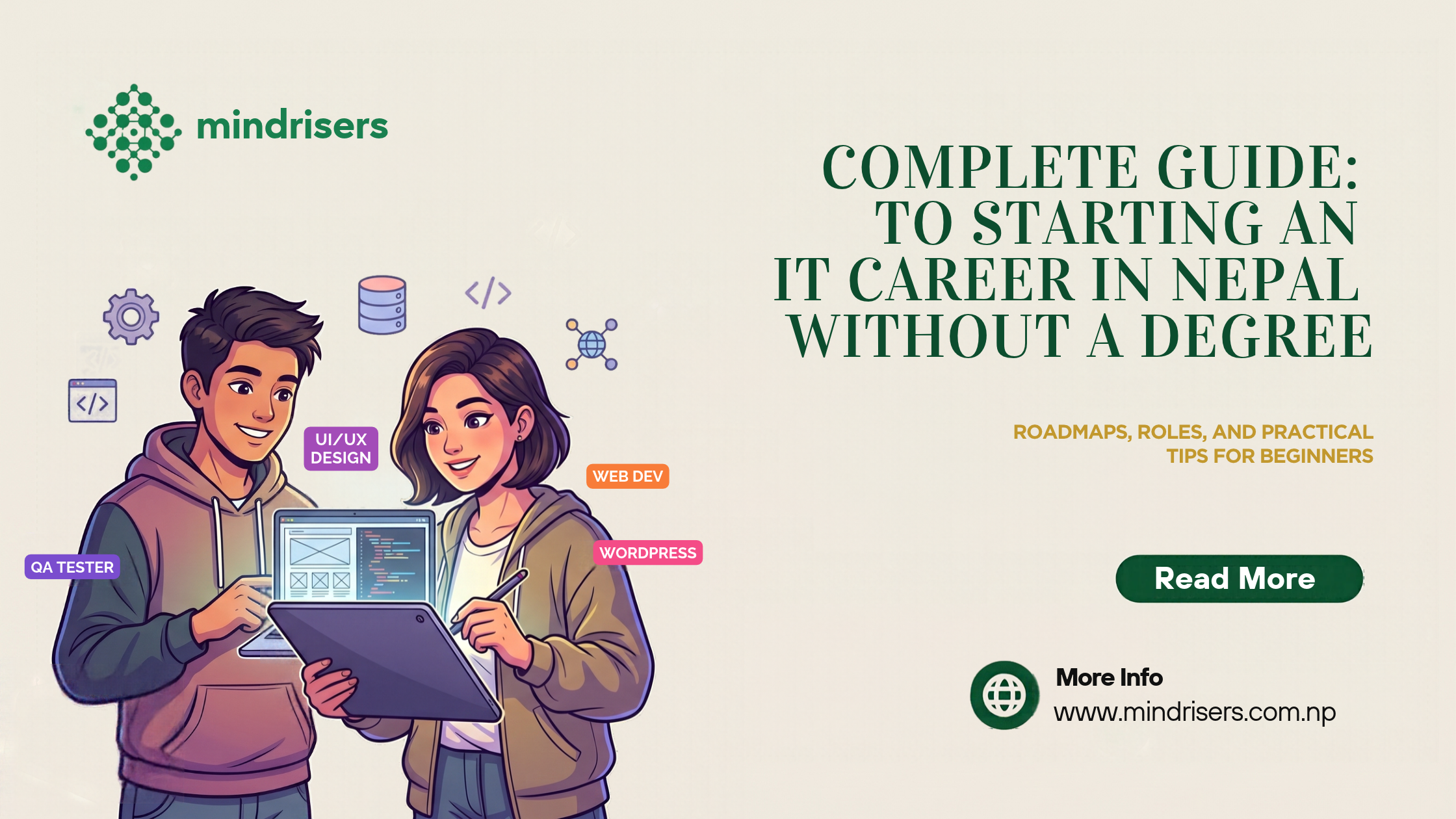
Kevin Joshi - Author
2026-11-18
Yes, you can start an IT career in Nepal without a degree. Roles like junior web developer, QA tester, UI/UX designer, WordPress developer and IT support are often filled by people who can prove their skills with real projects. But this is not true everywhere. Banks, telecom companies and government-linked organizations often treat a degree as compulsory, and you should know that before you decide.
This guide is written for Grade 11–12 students, +2 graduates and job seekers. It explains which jobs are realistic, what beginners can earn, what to learn first, and how to go from zero to your first interview in about 90 days of focused work.
Key takeaways
- Many small and mid-sized software companies, agencies and startups care more about your portfolio and interview than your degree. Banks, telecoms and government projects often do not.
- QA testing, WordPress, UI/UX, junior web development and IT support are the most reachable starting points.
- A certificate alone rarely gets you hired. Certificate + 2–3 real projects + an internship is a much stronger package.
- If you are still in +2, you do not have to choose between studying and learning IT. You can do both.
- Salary figures in this guide are rough ranges. Always check current job ads before you plan your finances.
Can You Get an IT Job in Nepal Without a Degree?
For many entry-level roles, yes. IT is one of the few fields where you can show your ability directly: a working website, a bug report, a Figma design, or a small app people can click and use.
The honest version is more useful than the hype you may see online:
- Easier without a degree: startups, digital agencies, small software houses, freelance work and many remote jobs.
- Harder without a degree: banks, insurance companies, telecom operators, government-linked projects, and some outsourcing contracts where the foreign client sets the staff requirements.
- Very hard without a degree (at the start): deep engineering roles such as embedded systems, machine learning research and senior data engineering.
So the real question is not only "Can I do it without a degree?" but "Which roles and companies match my situation?"
"Degree Required" vs & "Degree Preferred": How to Read Nepali Job Ads
Many job ads copy their requirements from an old template. Learning to read them saves you from rejecting yourself before you even apply.
What the ad says |
What it often means |
What to do |
|---|---|---|
|
"Bachelor's degree required" at a bank or telecom |
Often a real HR rule that the recruiter cannot waive |
Look at other employers first |
|
"Bachelor's degree preferred" at a startup or agency |
A filter for many applications, often negotiable |
Apply with a strong portfolio link |
|
"Degree or equivalent experience" |
Skills and projects are accepted |
Apply and lead with your best project |
|
"2 years experience" on a junior role |
Often a rough wish, not a strict rule |
Apply if you meet 60-70% of the skills |
IT Careers After SEE or +2: What Grade 11-12 Students Can Do Now
If you have just finished SEE, or you are in Grade 11 or 12, you do not need to drop your studies to start in IT. Many students learn a skill in the evening or on weekends while still in college.
Here is a realistic plan:
- During +2: spend 1-2 hours a day on one beginner skill, such as HTML and CSS, Figma, or manual software testing. Build one or two small projects, like a personal website or a school-club page.
- After +2: choose one route: a bachelor's degree such as BCA, BSc CSIT or BIT; a part-time job or internship alongside part-time study; or full-time practical training followed by job applications.
- Be honest with yourself: leaving school early or skipping a degree can close some doors later, such as certain government posts and some study-abroad options. If you can, finish +2 and build IT skills at the same time.
Best IT Jobs You Can Start Without a Degree
Role |
What to learn first |
Common tools |
Difficulty to enter |
|---|---|---|---|
|
QA / Software Tester |
Manual testing, bug reports, test cases |
Jira, Postman, basic SQL |
Easiest |
|
WordPress Developer |
WordPress, basic PHP, page builders |
Elementor, Figma |
Easy |
|
UI/UX Designer |
Design basics, wireframes, prototypes |
Figma |
Easy to medium |
|
IT Support / Helpdesk |
Troubleshooting, networks, communication |
Ticketing tools, remote desktop |
Easy |
|
Digital Marketing Executive |
SEO, social media, analytics |
Google Analytics, Meta Ads Manager |
Easy to medium |
|
Junior Web Developer |
HTML, CSS, JavaScript, one framework |
VS Code, Git, React |
Medium (very competitive) |
|
Mobile App Developer |
Dart and Flutter |
Flutter, Firebase |
Medium |
|
Networking / Cybersecurity Support |
Networking basics, Linux, security basics |
Certifications plus home-lab projects |
Medium to hard |
How to choose: if you like detail and finding mistakes, start with QA. If you like design, try UI/UX. If you enjoy building things step by step, try web development. Pick one and stay with it for at least three months.
How Much Can a Beginner Earn in Nepal Without a Degree?
Pay depends on the role, city, company size, your skills and your English. Treat these numbers as rough starting points. A July 2026 guide from Merokalam gives approximate ranges like these:
Stage |
Approximate range |
|---|---|
|
Internship |
Often a small stipend, sometimes unpaid |
|
Junior web developer or QA (Nepal) |
About NPR 25,000–45,000 per month |
|
Beginner freelancer |
About USD 5–15 per hour |
|
Experienced freelancer |
About USD 15–50 per hour |
Before you plan your budget, check recent listings on Merojob and Kumari Job to see what companies are offering today. Your first salary is a starting point, not your final level. Pay usually grows quickly once you have one or two years of real experience.
Self-Taught, IT Training Institute, or BCA/CSIT: Which Path Is Right?
Self-taught |
IT training institute (Mindrisers) |
BCA / BSc CSIT / BIT |
|
|---|---|---|---|
|
Time to first job |
Varies a lot |
Usually months |
3–4 years |
|
Structure and mentor |
None unless you find one |
Yes |
Yes, but more theory |
|
Cost |
Lowest (many free resources) |
Moderate (Best Value of money) |
Highest over the full course |
|
Degree on your CV |
No |
No |
Yes |
|
Best for |
Disciplined learners |
People who want guidance and projects fast ( Internship Gureenteed) |
People aiming at banks, government, study abroad or deep engineering |
These paths are not enemies. Many people start with a short practical course, get an internship, and study part-time for a degree later.
Step-by-Step: How to Start an IT Career Without a Degree
Step 1: Pick one field. Do not learn five things at once. Choose from the roles above and commit for 90 days.
Step 2: Learn the basics with structure. Use free resources, a training course, or both. Structure matters because it stops you from jumping between random videos.
Step 3: Build projects from week one. Start small: a personal website, a test report for a real app, or a redesign of a screen you use daily.
Step 4: Put your work online. Create a GitHub profile (developers), or a Behance or portfolio site (designers). Every project needs a live link.
Step 5: Get an internship or trainee role. An internship gives you a reference, team experience and real feedback that a certificate cannot.
Step 6: Apply early and often. You do not need to feel “ready”. Apply to junior and trainee roles while you keep learning.
Step 7: Keep learning after you are hired. Your first job is the start, not the finish line.
How to Build a Portfolio When You Have No Experience
One finished, live project is worth more than ten half-done tutorial copies. Pick a real problem, even a small one, such as an order tracker for a local shop or a booking page for a friend’s business.
Portfolio checklist
- A live link for every project
- A short case study: the problem, your solution, what you would improve
- A README that explains how the project works
- A mobile-friendly design
- Your contact details and CV link in plain sight
- No broken links or unfinished pages
GitHub checklist (developers)
- Clear commit messages, not just “update”
- Activity over weeks, not one big upload
- Your best projects pinned
- No passwords or secret keys in your code
Weak: “Made a to-do app using React.”
Strong: “Built a task tracker for small teams. Reduced duplicate server requests by delaying API calls. Live demo and GitHub link included.”
Skills Employers Actually Test
Interviewers for junior roles usually care about how you think, not only what you memorized. Expect:
- A small practical task, such as finding a bug, building a simple page or testing a form.
- A walkthrough of your own project. You may be asked why you made a choice or what you would change.
- Communication. Clear emails, bug reports and updates matter, especially for companies that work with foreign clients.
Before every interview, explain each of your projects out loud to a friend. If you stumble there, you will stumble in the interview.
English matters. Many Nepali IT companies work with international teams. You do not need perfect English, but you should be able to write clear messages and understand written instructions. Practice by writing short project notes and bug reports in English.
Do Certificates Matter? Will Companies Check Them?
A certificate shows you finished a course. It does not prove what you can do. Employers usually ask for proof through a practical test or portfolio review.
Certificates help most when they are paired with a project that uses the skill, for example a cloud certificate next to a small deployed project, or a networking certificate next to a home-lab write-up.
As for verification, larger and more regulated organizations usually check educational documents. Many small software houses and agencies are more relaxed for junior roles, but you should never assume. If it affects your decision, ask politely during the hiring process.
Will AI Take Away Entry-Level IT Jobs?
AI tools now help people write code, test software and create designs faster. That changes how juniors should learn, but it does not remove the need for people who understand the work.
What tends to matter more now:
- Fundamentals. If you cannot understand code or test results, you cannot check whether AI output is right.
- Using AI as a helper, not a replacement. Learn the basics first, then use AI tools to work faster.
- Explaining your own work. Interviewers can quickly tell when someone pasted code they do not understand.
This is an observation from how hiring is changing, not a guarantee. Keep following job ads in your target field so you can see which skills employers ask for each year.
Freelancing and Remote Work From Nepal
Freelancing lets you start without waiting for a job offer. You build a profile, pitch small projects and collect reviews. It can pay in dollars, but it is more competitive because you compete with people worldwide.
- Start with one narrow service, such as WordPress fixes, landing pages or QA testing.
- Expect to need a strong portfolio and good written English.
- Many people work locally first, then move to remote clients after they have a track record.
- Once you earn from foreign clients, learn the PAN and tax rules. Check current requirements with the Inland Revenue Department or a qualified accountant.
Remote foreign jobs are a great long-term goal but rarely the easiest first job.
Where to Find Your First IT Job in Nepal
- Job portals: check Merojob and Kumari Job weekly, not once.
- LinkedIn: keep your profile current with your portfolio link near the top. Recruiters search here.
- Facebook groups and Telegram channels: small companies often post openings here that never reach the big portals.
- Direct outreach: find a small company on LinkedIn, mention a specific project of theirs, attach your portfolio and ask if they have junior or internship openings.
- Your network: classmates, course friends and mentors. Give value first (share something useful, comment thoughtfully) before you ask for a referral.
When you apply, tailor your CV and put your most relevant project first. Fifteen tailored applications usually beat fifty copy-pasted ones.
A 90-Day Roadmap for Beginners
Days 1–30: Foundations. Pick one role. Learn the basics daily. Start your first project in week one, even if it is tiny.
Days 31–60: Build and prove. Finish and publish one flagship project. Write its case study. Create your CV, LinkedIn and GitHub or portfolio. Start applying for internships and trainee roles.
Days 61–90: Apply and improve. Apply regularly, take a small freelance task if possible, practise mock interviews, and improve your CV from the feedback you get.
This is a starting plan. Some people need longer, and that is normal. Steady daily practice beats a short burst of effort.
How to Choose an IT Training Institute (and Avoid Common Traps)
A course can speed up your learning, but not every institute is a good fit. Before you pay, check these points:
- Syllabus: does it match what job ads in your chosen role ask for?
- Projects: will you build real projects, or only watch lectures?
- Mentors: can you meet the instructors and see their experience?
- Internship or placement claims: ask exactly what is promised, for whom, and under what conditions. Get it in writing.
- Past students: ask to speak with recent graduates and check their work.
- Fees: ask for the full cost, including any extra charges.
- Schedule: do morning, evening or weekend batches fit your school or job?
Be careful with any institute that promises a job without explaining the conditions.
Mindrisers courses for beginners
Mindrisers Institute of Technology is a Kathmandu-based training institute. According to third-party directory coverage, it offers courses in areas such as MERN stack and full stack development, QA, UI/UX design, Flutter, digital marketing, data science and AI, cybersecurity, DevOps and React. Based on the roles in this guide, these are the courses most relevant for beginners:
- Want to build websites? Explore the Full Stack and MERN stack courses.
- Prefer finding bugs and testing apps? Explore the QA (software testing) course.
- Love design? Explore the UI/UX design course.
- Want to build mobile apps? Explore the Flutter app development course.
- Interested in online business and marketing? Explore the Digital Marketing course.
- Curious about data, AI or security? Explore Data Science and AI or Cybersecurity.
Not sure where to start? Visit the Mindrisers website to compare course details, batch timings and fees, and ask the team about internship conditions before you enrol.
Common Mistakes Beginners Make
- Learning five tools at once. Master one path first.
- Only watching tutorials. Build, break and fix things yourself.
- Hiding your work. If a recruiter cannot click a link, your project does not exist to them.
- Waiting for the perfect moment to apply. Interviews teach you faster than another month of study.
- Ignoring communication. Technical skill alone does not carry you in client-facing teams.
- Choosing a course only because it is cheap or only because it is famous. Check the syllabus, projects and mentors.
- Applying only to senior roles. Target junior, trainee and internship listings.
When a Degree Is Still the Better Choice
A degree is not a bad idea. It can help if you want to work at a bank, telecom or government organization, plan to study or work abroad, or feel your fundamentals are weak and you need structured learning. Many colleges also have internship links and alumni networks.
If you skip or delay a degree, make up for it with stronger proof: real projects, freelance or internship experience, a technical blog, hackathons and good professional relationships.
The best choice depends on your goals, family situation and budget. Neither path is right for everyone.
Frequently Asked Questions
Can I get an IT job in Nepal without a degree? Yes, for many junior roles at startups, agencies and small software companies. It is harder at banks, telecoms and government-linked organizations.
Can I start an IT career after SEE? Yes, you can begin learning right after SEE. The safest plan is to continue +2 and build IT skills alongside it, so you keep more options open.
Can I start an IT career after +2? Yes. After +2 you can join a bachelor’s program, work or intern while studying part-time, or take practical training and apply for junior roles.
Which IT job is easiest to get without a degree? QA testing, WordPress development, IT support and UI/UX design usually have the lowest entry barrier. Junior web development is possible but more competitive.
How long does it take to become job-ready? It depends on the field, your practice time and the quality of guidance. Many learners aim for roughly three to six months of focused work before applying for internships or junior roles.
Is a certificate enough? No. Combine a certificate with two or three real projects and, if possible, an internship.
Do I need to be good at math to start? Not for every role. QA, UI/UX, WordPress and digital marketing need very little advanced math. Some data and AI roles need more.
Am I too old to switch to IT? No. Employers care about what you can do. Career changers can use skills from their old job, such as communication, accounting or project management.
Should I do an internship first or start freelancing? For most beginners, an internship is the lower-risk start because you get mentoring and real team experience. Confident self-starters can try small freelance projects, and many people do both.
Can I get a government IT job without a degree? Usually not. Government and government-linked roles often have fixed education rules. Check each vacancy notice for exact requirements.
Final Thoughts
Starting an IT career in Nepal without a degree is possible, but it takes focus. Choose one field, learn it with structure, build real projects, put them online and apply for internships and junior roles. Be honest about the roles where a degree still matters, and keep your options open if you are still in school.
Your next step this week: pick one role from the table above, spend one hour on a free resource, and start your first small project.
Recent
Recent Post
View All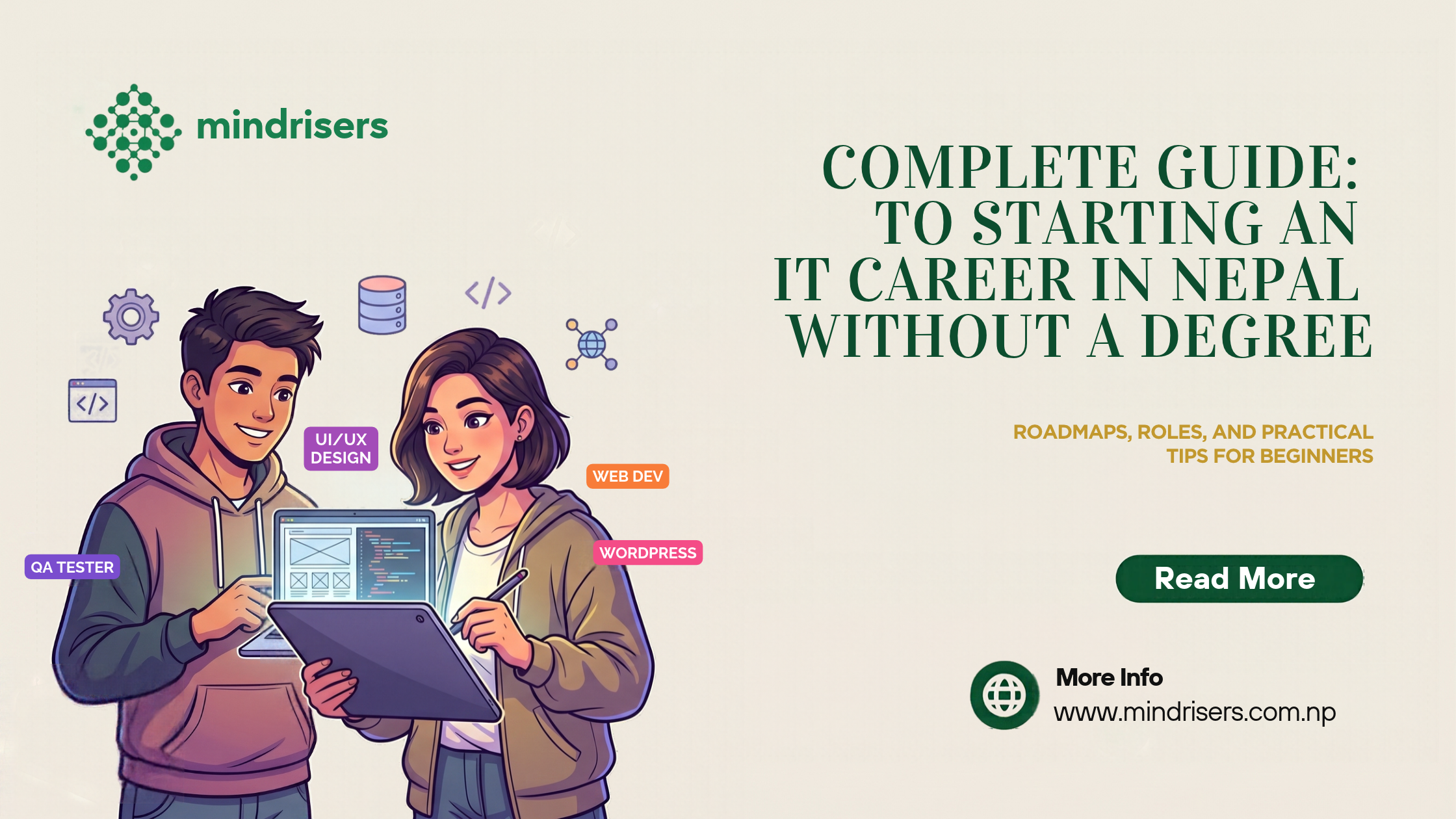
Complete Guide: To Starting an IT Career in Nepal Without a Degree
2026-11-18.810 Views
From Classroom Learning to Real-World Experience: My First Step into Digital Marketing
2026-08-24.745 Views
Inside Mindrisers Cybersecurity Course: Modules, Tools & Career Paths Explained
2026-08-13.815 Views
What Are the Benefits of AI-Powered Cybersecurity Training?
2026-08-10.798 Views

Never miss an Opportunity !
Want to learn TOP 2025 IT Skills ?
We open IT skill classes Monthly in Design, Development, Deployment, Data etc.
Have something to Ask ?
get admission enquiry
