
Astha Chhatri - Author
2026-08-13
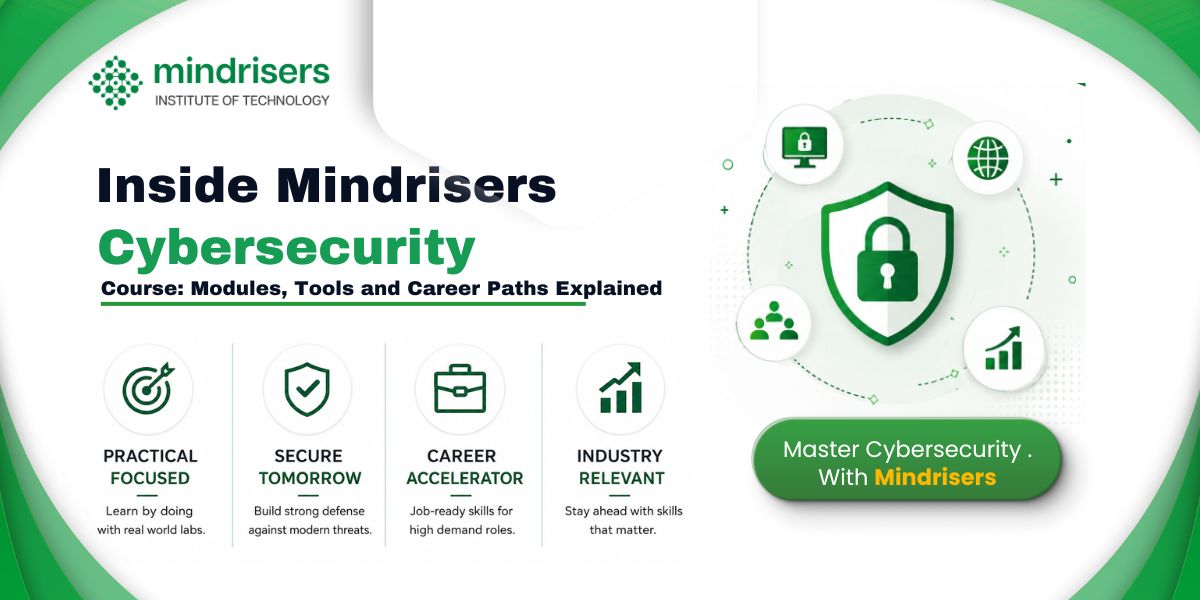
You have learned about new additions to our Cybersecurity training with AI, understood the rationale behind the recent updates, and seen the benefits derived from updated cybersecurity course. Now it is time to look at the course itself and discover what it entails.
After all, a potential candidate needs information about what they will study to pursue the career of their choice or upskill in a particular field. Mindrisers Institute reimagined its cybersecurity course to meet the demands of the modern-day cybersecurity landscape by combining classroom training with cutting-edge technologies, industry-standard tools, and advanced security practices, including AI workflow.
Module 1 – Introduction to Cyber Security
Before diving into attacks and defenses, students need to get acquainted with basic terms and be familiar with the working environment in which they will operate further during the course. This module covers the essentials of Cyber Security.
What You Will Learn
- What cybersecurity is and why it matters in the modern digital world
- Common categories of cyber threats: malware, phishing, ransomware, and more
- Core cybersecurity terminology used throughout the course
- Essential Linux commands used in day-to-day security work
Module 2 – Cyber Security Basics
After reviewing the essential concepts, you will proceed to the principles of Cyber Security. You will learn the fundamental ideas guiding cybersecurity and affecting the day-to-day operations in the industry.
What You Will Learn
- The CIA Triad: Confidentiality, Integrity, and Availability
- Authentication, Authorization, and Accounting (AAA)
- Common categories of cyberattacks and vulnerabilitie
- Risk and compliance associate
Module 3 – Network Security
Networks are the foundation of every infrastructure, and attacks surface most often on network resources. It is necessary to understand network concepts and learn how to protect networks and the data that traverses them.
What You Will Learn
- Core networking concepts
- The OSI and TCP/IP models
- Key protocols: HTTP, HTTPS, FTP, DNS, and others
- Firewall types, configuration, and security
- VPNs and encryption fundamentals
Industry Tools You Will Learn
- Firewalls and VPN platforms
- Network configuration utilities
Module 4 – Cryptography
Data encryption is at the heart of much of modern cybersecurity. This module explains how to work with cryptographic data, which consists of secrets, ciphers, and hashes. You will learn how to protect digital data and communications from unauthorized access and establish confidence between communicating parties.
What You Will Learn
- Fundamentals of cryptography and cryptographic algorithms
- Symmetric vs. asymmetric encryption
- Public Key Infrastructure (PKI)
- Hashing algorithms: MD5, SHA-1, SHA-256
- Digital signatures and certificates
Module 5 – Malware and Malware Analysis
It is essential to understand how malicious software works to protect systems from it. This module covers malware concepts, classifications, and tools for detecting and analyzing malicious code. You will learn how to use the latest methods for analyzing and eliminating computer viruses.
What You Will Learn
- Types of malware: viruses, worms, trojans, ransomware, and more
- How malware spreads and infects systems
- Tools used for malware detection and analysis
- Basics of reverse engineering malware
- Best practices for malware prevention
Module 6 – Web Security
Web applications are an attractive target for cyber attackers, and any organization dealing with user data, such as government portals, banking systems, and e-commerce platforms, relies on web application security to protect its users’ data. The Web Security module teaches penetration testing basics, including how to recognize and mitigate the most common web application vulnerabilities.
What You Will Learn
- Burp Suite proxy configuration and traffic interception
- Inspection and replay of HTTP requests
- OWASP Top 10 web application vulnerabilities
- Common attack types: XSS, SQLi, SSRF, and more
- Web Application Firewalls (WAF)
- Secure coding practices for modern web development
- Responsible disclosure and vulnerability reporting
Industry Tools You Will Learn
- Burp Suite
- Browser developer tools
- Web application labs
Module 7 – Mobile Application Security
With mobile applications taking over digital services, mobile application security has become one of the fastest-growing areas of cybersecurity. In this module, you will learn Android application security basics, including reverse engineering and popular mobile application penetration testing methodologies.
What You Will Learn
- APK structure and decompilation
- AndroidManifest.xml analysis - permissions and hardcoded secrets
- Intercepting APK traffic using Burp Suite
- Testing Android apps in an emulator
- AI-assisted analysis of native .so libraries and app files
Industry Tools You Will Learn
- Android emulators
- APK decompilers
- Burp Suite
- AI-based analysis tools
Module 8 – Identity and Access Management (IAM)
One of the most critical aspects in any enterprise is who has access to which data and systems. In this module, you will explore fundamental concepts of IAM (Identity and Access Management) and gain an overview of the most important technologies and methods for managing employee access to information.
What You Will Learn
- IAM fundamentals
- Multi-Factor Authentication (MFA)
- Identity federation and Single Sign-On (SSO)
- Managing user access in enterprise environments
- Role-Based Access Control (RBAC)
Module 9 – Cyber Security Tools and Technologies
This module covers the software tools that make up the working environment for security analysts and ethical hackers. You will explore the concepts of computer security, intrusion detection and prevention systems, network sniffing, and packet analysis and study fundamental tools for protecting networks and computer systems.
What You Will Learn
- Security Information and Event Management (SIEM) systems
- Intrusion Detection Systems (IDS) and Intrusion Prevention Systems (IPS)
- Network sniffing and traffic analysis
- Vulnerability scanning and penetration testing tools
Industry Tools You Will Learn
- Wireshark
- Nessus
- Metasploit
Module 10 – Cloud Security
Many organizations are migrating their systems and applications to the cloud. However, this transition creates new security challenges since the cloud introduces new attack surfaces that require specialized security assessments. This module covers the fundamentals of cloud security, cloud attack surfaces, and techniques for discovering and verifying cloud vulnerabilities.
What You Will Learn
- Fundamentals of cloud computing and cloud security
- Cloud metadata services and SSRF
- Amazon S3 bucket security
- Using the AWS CLI to identify and exploit S3 misconfigurations
- IAM misconfigurations in cloud environments
Industry Tools You Will Learn
- AWS CLI
- Cloud lab environments
- Cloud security platforms
Module 11 – Incident Response and Disaster Recovery
A cyberattack can cause significant damage if not properly mitigated. In this module, you will learn the concepts and practices of the incident response lifecycle, as well as the tools and procedures for detecting and analyzing incidents. You will also learn the basics of forensics, data recovery, and business continuity.
What You Will Learn
- The incident response lifecycle
- Tools and techniques for incident detection and response
- Forensic analysis and evidence gathering
- Disaster recovery planning and backup strategies
- Business continuity principles
Module 12 – Ethical Hacking and Penetration Testing
This module teaches you how to practice ethical hacking and penetration testing. You will learn about offensive security basics and get an overview of the penetration testing process, from reconnaissance to reporting.
What You Will Learn
- Introduction to ethical hacking
- Penetration testing methodology and tooling
- Information gathering and reconnaissance
- Vulnerability analysis and exploitation
- Post-exploitation techniques and professional reporting
Module 13 – Security Operations and Monitoring
The SOC (Security Operations Center) team is tasked with ensuring the uninterrupted operation and safety of information systems with minimal losses and damage. In this module, you will learn and practice the core competencies of the Security Operations Center analyst: log monitoring and incident response.
What You Will Learn
- Overview of Security Operations Centers (SOC)
- Log management and analysis
- Incident detection and handling
- Threat intelligence and threat hunting
- Security metrics and reporting
Module 14 – Advanced Threats and Attack Techniques
This module teaches students about advanced attacks and the latest cyber security threats. You will learn the techniques, technologies, and procedures attackers use to maximize damage to systems and data, as well as how to prevent them.
What You Will Learn
- Advanced Persistent Threats (APTs)
- Social engineering: phishing, spear phishing, vishing
- Zero-day exploits and how to defend against them
- Denial of Service (DoS) and Distributed Denial of Service (DDoS) attacks
- Countermeasures against advanced attacks
Module 15 – AI for Security
This module teaches students about advanced attacks and the latest cyber security threats. You will learn the techniques, technologies, and procedures attackers use to maximize damage to systems and data, as well as how to prevent them.
What You Will Learn
- Introduction to AI-driven cybersecurity
- Model Context Protocol (MCP) and AI
- AI-based source code analysis
- AI-based penetration testing
- Building your own simple AI security tools
- Working with ShellGPT
Industry Tools You Will Learn
- Snort
- AWS GuardDuty
- AWS Macie
- Amazon Detective
- AI code-analysis and pentesting tools
- Security operations engineer
Module 16 – Capstone Project
This module teaches students about advanced attacks and the latest cyber security threats. You will learn the techniques, technologies, and procedures attackers use to maximize damage to systems and data, as well as how to prevent them.
What You Will Do
- Conduct a full penetration test on a vulnerable system
- Identify and exploit vulnerabilities in a controlled environment
- Write a professional security report with remediation recommendations
- Deliver a final presentation demonstrating project results
How These Modules Work Together
One of the advantages of the Mindrisers cybersecurity course is that the taught concepts are not isolated from each other. Instead, you will notice that what you have learned is used in subsequent modules as well. For example, the basics of networking and cryptography will be useful in securing the web and mobile app, and offensive security fundamentals will give you a solid foundation for cloud security, penetration testing, and incident response. Moreover, the skills you have acquired while working with monitoring and response systems will allow you to understand the basics of AI security and its application in practice. Thus, at the end of the course, you will not only have mastered individual areas but also will be able to see the bigger picture. You will have a general idea of how an organization’s security works and what steps must be taken to protect systems and data from known and emerging threats.
Practical Learning That Prepares You for the Real World
Employers are looking for cybersecurity professionals who understand the actual implementation of penetration testing, vulnerability assessment, and other aspects of cybersecurity beyond the theoretical knowledge. That is why the updated curriculum focuses on:
• Hands-on labs and real-world attack simulation
• Practical penetration testing procedures
• Industry-standard cybersecurity tools
• Security reporting and documentation
• Best practices for responsible disclosure
• AI-assisted procedures
Such an approach ensures that students are well-prepared for the practical aspects of the job.
Which Career Path Can This Course Lead To?
The course offers a comprehensive understanding of cybersecurity and prepares students for a variety of careers, including:
Ethical hackers
• Penetration tester
• Security analyst
• Application security engineer
• Mobile security tester
• Cloud security analyst
• DevSecOps engineer
• Vulnerability assessment specialist
• AI security researcher
• Security automation engineer
• Red team specialist
• And various other entry-level cybersecurity roles
Since the curriculum covers Web Security, Mobile Application Security, Cloud Security, and AI for Cybersecurity, students can diversify their skill sets to meet the needs of various employers.
Continue Exploring the Cybersecurity Learning Experience
If this is the first article you are visiting in this blog series, we recommend that you visit the following web pages to understand why we have made the updates and how they benefit you:
• Mindrisers’ Updated Cybersecurity Course: AI-Integrated Training for the Future
• Artificial Intelligence is Taking over CyberSecurity
• What are the benefits of AI-powered cybersecurity training?
Having discussed the course modules and the learning outcomes, let us take a closer look at why Mindrisers cybersecurity courses are fundamentally different from similar programs.
What Makes Mindrisers' Approach Different
Many cybersecurity courses claim to provide practical knowledge, but they lack the comprehensive approach that real-world ethical hacking and penetration testing require. Mindrisers Institute was created to bridge the gap between theoretical knowledge and practice. Our cybersecurity course focuses on preparing students for real-life situations by teaching them the key concepts and procedures that security analysts, ethical hackers, and penetration testers use daily. Thus, instead of treating individual areas (networking, cryptography, web and mobile app security, IAM, cloud computing, incident response, etc.) as separate entities, we try to show students how to use the knowledge in practice. You will not only learn the attacking techniques but also understand how to defend against them, which is extremely important for any career in cybersecurity. In addition, students will gain practical experience by working with professional-grade tools used by penetration testers and security analysts in the industry.
Frequently Asked Questions
1.Do I need to have a Technical Background to take this course?
Mindrisers Cybersecurity course will take you from the very basics of cybersecurity to advanced penetration testing procedures. Although some networking and programming knowledge will be beneficial, the course is suitable for students with no technical background, as well as experienced network administrators and system engineers who wish to specialize in the field of cybersecurity.
2.Will I get hands-on lab access?
Yes, you will. All modules, including Web Security, Mobile Application Security, Cloud Security, and AI for Cybersecurity, have dedicated lab sections. They will give you the much-needed practice and confidence to proceed to the actual penetration testing activities.
3.How is AI used in the course?
You will learn how to use various AI tools for code analysis, mobile app assessment, vulnerability scanning, and more. In other words, you will see how AI will be integrated into the daily operations and significantly expedite the processes of penetration testing and security assessments.
4.Can this course help me switch careers into cybersecurity?
Yes, it can. The Mindrisers Cybersecurity course curriculum is perfect for both aspiring cybersecurity professionals and those looking to change careers. It will provide you with the needed fundamental knowledge while teaching advanced penetration testing procedures that can be used to gain the top cybersecurity jobs. Specifically, the course prepares you for the positions of Ethical Hacker, Penetration Tester, Security Analyst, Cloud Security Analyst, DevSecOps Engineer, Security Automation Engineer, AI Security Researcher, and many other roles in cybersecurity.
Ready to Get Started?
There are numerous career opportunities in the cybersecurity field. However, they require more practical experience and knowledge than theoretical understanding. That is why Mindrisers Institute has introduced Cybersecurity training with AI, which gives you the hands-on experience needed to become an industry-ready cybersecurity expert. If you have already read the previous blog posts in this blog series and understood the value of our updated curriculum, it is time to schedule a consultation with the Mindrisers Institute and discuss your goals. Whether you want to become an Ethical Hacker, a Cloud Security Analyst, or an AI Security Researcher, the journey toward these fascinating careers always starts with the same first step, learning about the fundamentals and practicing your penetration testing skills
Start Building Your Cybersecurity Career with Mindrisers
There are numerous career opportunities in the cybersecurity field. However, they require more practical experience and knowledge than theoretical understanding. That is why Mindrisers Institute has introduced Cybersecurity Training with AI , which gives you the hands-on experience needed to become an industry-ready cybersecurity expert. If you have already read the previous blog posts in this blog series and understood the value of our updated curriculum, it is time to schedule a consultation with the Mindrisers Institute and discuss your goals. Whether you want to become an Ethical Hacker, a Cloud Security Analyst, or an AI Security Researcher, the journey toward these fascinating careers always starts with the same first step learning about the fundamentals and practicing your penetration testing skills.
Recent Post
View All
From Classroom Learning to Real-World Experience: My First Step into Digital Marketing
2026-08-24.411 Views
Inside Mindrisers Cybersecurity Course: Modules, Tools & Career Paths Explained
2026-08-13.466 Views
What Are the Benefits of AI-Powered Cybersecurity Training?
2026-08-10.476 Views
Artificial Intelligence is Taking over CyberSecurity
2026-08-04.508 Views

Never miss an Opportunity !
Want to learn TOP 2025 IT Skills ?
We open IT skill classes Monthly in Design, Development, Deployment, Data etc.
Have something to Ask ?
get admission enquiry