
Mindrisers - Author
2026-11-20
Imagine a student we will call Anisha. She has just finished SEE. Her cousin says, “Learn coding, you will earn well.” Her neighbour says, “Do science, then engineering.” A YouTube video says, “You don’t need college at all.” Everyone sounds sure. Anisha feels more confused than before.
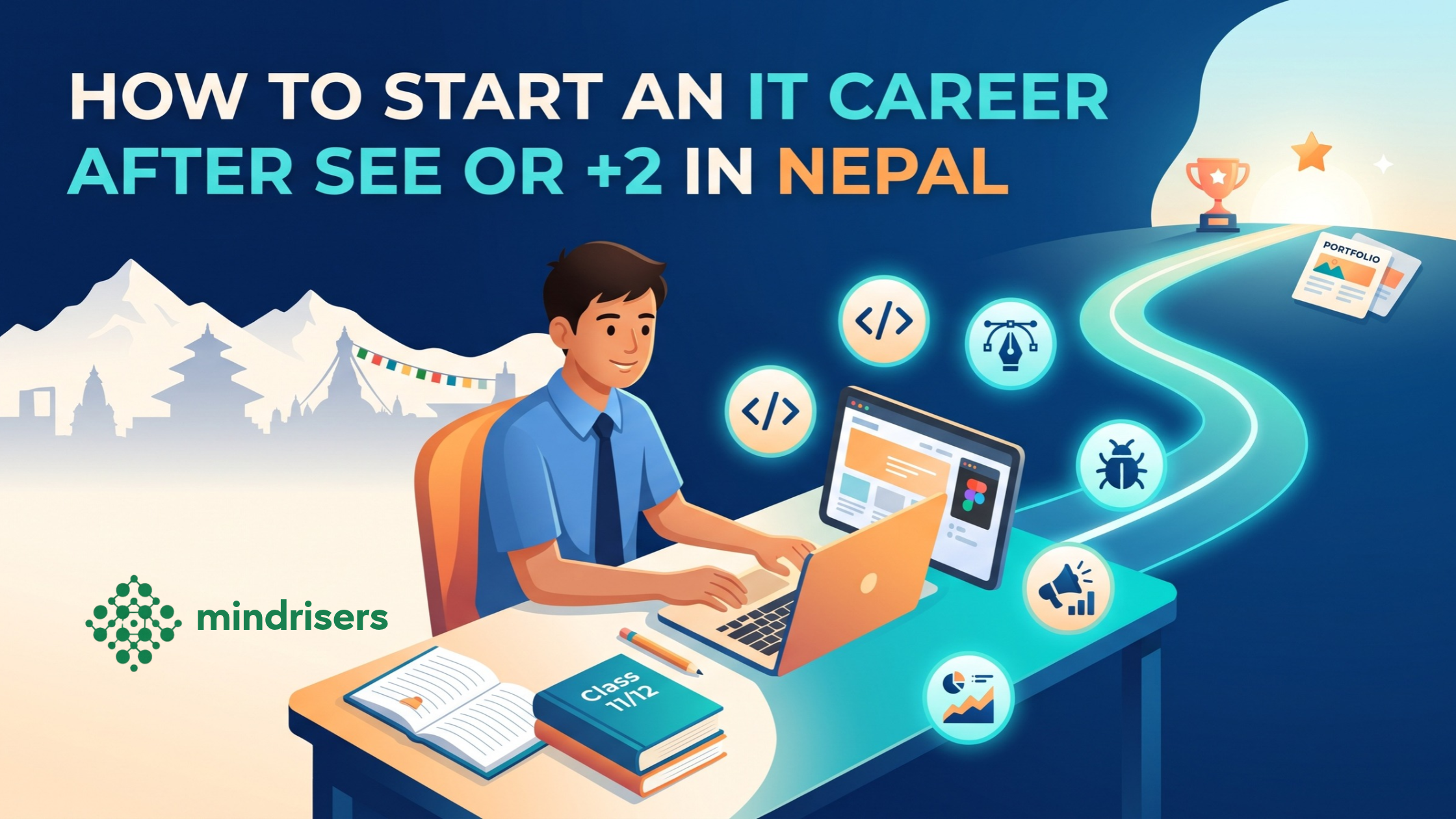
If that sounds like you, this guide is for you. It explains, in plain steps, how to build an IT career after SEE or +2 in Nepal, what to learn first, and how to choose between a bachelor’s degree, practical training and an internship.
Quick answer: You can start learning IT skills right after SEE, and you can keep studying at the same time. For most students, the safest plan is to finish +2, learn one beginner skill alongside it, build two or three small projects, and then choose your next step with real information instead of pressure.
This article is part of our bigger guide: The Complete Guide to Starting an IT Career in Nepal Without a Degree.
Do You Have to Choose Between +2 and IT?
No. This is the biggest myth. You do not have to quit school to learn IT, and you do not have to wait for a degree to begin.
Think of it as two tracks running together:
- Track 1: your studies. Your +2 or diploma keeps your options open for bachelor’s programs, government exams and study abroad.
- Track 2: your skills. One or two hours a day on a beginner IT skill builds a portfolio before you even finish school.
Students who do both usually reach the end of +2 with something real to show, such as a small website, a design case study or a test report. That puts them far ahead of someone who starts from zero after results.
Which Stream or Course After SEE Helps Most for IT?
IT skills can be learned from any stream. But some choices make the next steps smoother.
|
Option after SEE |
How it helps IT |
Things to check |
|---|---|---|
|
+2 Science (Computer group) |
Common route towards BSc CSIT, BCA, BIT and engineering |
Maths and science workload is heavier |
|
+2 Management |
Works well for IT support, digital marketing, BCA and business-focused tech roles |
Check college admission rules for IT degrees |
|
+2 Humanities |
Good for design, content, UX writing and digital marketing |
Some IT degrees may have extra requirements |
|
Diploma in computer engineering (CTEVT) |
Practical, job-focused, and some students continue to further study |
Check duration, eligibility and recognition |
|
A Levels |
Flexible, often preferred for study abroad |
Usually higher fees |
Admission rules change by university, college and year. Before you decide, read the latest admission notice from the college or university, or ask a counsellor. Do not rely on a single blog post, including this one.
What to Learn in Grade 11 vs Grade 12
Here is a simple timeline you can adjust.
|
Stage |
Goal |
What to do |
|---|---|---|
|
After SEE or early Grade 11 |
Explore |
Try three beginner skills for one week each (for example HTML and CSS, Figma, and manual testing). Notice which one you enjoy. |
|
Grade 11 |
Learn one skill |
Pick one path and study 1–2 hours a day. Build your first small project. |
|
Grade 12 |
Build proof |
Make 2–3 projects, put them online, and write a short case study for each. Try a small freelance or volunteer task. |
|
After +2 |
Decide |
Choose a bachelor’s, a practical course, an internship, or a mix. |
Six beginner skills to try
|
Skill |
Good first project |
Free place to start |
|---|---|---|
|
HTML and CSS (web) |
A personal website or school-club page |
|
|
JavaScript basics |
A simple calculator or quiz |
|
|
UI/UX design |
Redesign one screen of an app you use |
Figma free plan |
|
Manual software testing |
Test a practice website and write bug reports |
Practice sites built for testers, such as Sauce Demo |
|
Digital marketing basics |
A page and three posts for a small local business |
Platform help centres and free course materials |
|
Computer basics and problem-solving |
Short logic exercises |
A Weekly Study Plan That Fits School
You do not need eight hours a day. Consistency beats intensity.
- Monday to Friday: 60–90 minutes after school or tuition. One lesson, one small practice task.
- Saturday: 2–3 hours on your project. Build something, even if it is small.
- Sunday: rest, or 30 minutes to review what you learned and plan next week.
During exam weeks, cut back to 20–30 minutes so you do not lose the habit. A student who studies 90 minutes a day for a year will usually learn far more than one who studies ten hours in a weekend and then stops.
Do You Need an Expensive Laptop?
Not to start. A basic laptop that opens a browser and a code editor smoothly is enough for learning web basics, testing and a lot of design work. Heavier work such as video editing, 3D or large app builds may need a stronger machine later. Wait until you know which path you like before spending on powerful hardware.
After +2: Three Realistic Paths
There is no single right answer. Compare them honestly.
|
Bachelor’s (BCA, BSc CSIT, BIT) |
Practical training + internship |
Work or freelance + part-time study |
|
|---|---|---|---|
|
Time |
About 3–4 years |
Often months |
Flexible |
|
Strength |
Degree on your CV, theory, college network |
Fast, hands-on, portfolio-focused |
Earns while learning |
|
Watch out for |
More theory, higher total cost |
Quality varies, so check the syllabus and projects |
Needs discipline and a good schedule |
|
Best if |
You want banks, government, study abroad or deep engineering |
You want to enter junior roles quickly |
You need income soon |
Many people mix these. For example, they take a short practical course after +2, get an internship, and study part-time for a degree later. The point is to decide with facts, not fear.
How to Talk to Your Parents About an IT Career
Many parents worry that skipping a degree is risky. They are not wrong to worry, so answer the worry directly.
- Show the plan, not just the dream. Bring a simple timeline: study, skill, project, internship.
- Keep your studies. Say clearly that you are not dropping +2.
- Show real examples. Open job ads on Merojob or Kumari Job together and look at what junior roles ask for.
- Be honest about limits. Admit that some jobs, such as banks and government roles, usually need a degree, and explain how you will keep that option open.
- Offer a trial period. For example, “Let me try this for three months and show you my first two projects.”
Common Mistakes Grade 11–12 Students Make
- Choosing because friends chose. Your best path is the one that fits your interests and situation.
- Starting five skills at once. Pick one and stay with it for 90 days.
- Buying courses before trying free lessons. Test your interest first.
- Only watching tutorials. Build something every week.
- Believing every “guaranteed job” promise. Ask exactly what is guaranteed, for whom and under what conditions.
- Ignoring English. Practise reading and writing short technical notes in English. It helps in nearly every IT role.
- Forgetting to save your work. Put projects online so you can share a link.
A 30-Day Starter Challenge
Use your SEE break, a holiday, or any month you can spare.
Week 1: Explore. Try HTML and CSS, Figma and manual testing for two days each. Write down what you enjoyed.
Week 2: Choose. Pick the one you liked most. Follow one free course and take notes.
Week 3: Build. Make one small project from scratch, such as a one-page website, a redesigned app screen or a test report.
Week 4: Share. Put it online, ask a teacher, senior or mentor for feedback, and improve it once.
At the end of 30 days you will know whether this path suits you, and you will have your first project.
How a Training Course Can Help (and How to Choose One)
Free resources are great, but many students struggle without feedback. A good course gives structure, a mentor who reviews your work, and a group to learn with. Before you pay, check these:
- Does the syllabus match what junior job ads ask for?
- Will you build real projects, or only watch lectures?
- Are there morning, evening or weekend batches that fit your school schedule?
- What exactly does the internship or placement support include, and under what conditions?
- Can you speak to recent students and see their work?
- What is the complete fee, including extra charges?
Beginner-friendly courses at Mindrisers
Mindrisers Institute of Technology is a Kathmandu-based institute. According to third-party directory coverage, its courses include areas such as full stack and MERN development, QA, UI/UX design, Flutter, digital marketing, data science and AI, and cybersecurity. Here is how they map to the beginner skills above:
- Like building websites? Look at the Full Stack and MERN courses.
- Like finding mistakes and testing? Look at the QA course.
- Like design? Look at the UI/UX course.
- Want to build mobile apps? Look at the Flutter course.
- Like online business and social media? Look at the Digital Marketing course.
Visit the Mindrisers website to compare syllabus, batch timings and fees, and ask about school-friendly schedules before you enrol.
Frequently Asked Questions
Can I start an IT career after SEE? Yes, you can start learning right after SEE. The safest plan is to continue +2 or a diploma and build skills alongside it.
Can I start an IT career after +2? Yes. After +2 you can join a bachelor’s program, take practical training, intern, or combine them.
Is +2 Science necessary for an IT career? Not for every IT role. Many roles such as QA, UI/UX, WordPress and digital marketing welcome students from any stream. Some degrees and engineering paths do prefer science, so check admission rules.
Should I do BCA, BSc CSIT or a short course? It depends on your goal. Choose a degree if you want banks, government, study abroad or deep engineering. Choose a short practical course if you want to enter junior roles sooner. You can also combine them.
How many hours a day should I study IT? One to two hours a day is enough to start while in school. Consistency matters more than long, irregular sessions.
Can I get an IT job while studying? Some students find internships, trainee roles or small freelance work while studying, especially in QA, design, WordPress and digital marketing. Make sure the schedule does not hurt your exams.
Do I need to be good at math? Not for every role. QA, UI/UX and digital marketing need little advanced math. Some data and AI roles need more.
Final Thoughts
You do not have to decide your whole life at 16 or 18. You only need to take the next small step: try one skill, build one small project and talk to people who work in the field. If you want the full roadmap, read our guide on starting an IT career in Nepal without a degree, then try the 30-day challenge above.
Recent
- 01What Should You Learn in a Data Science with AI Course in Nepal? A Practical Roadmap for 2027
- 02IT Career After SEE and +2 in Nepal: A Practical Guide for Grade 11–12 Students (2027)
- 03Complete Guide: To Starting an IT Career in Nepal Without a Degree
- 04From Classroom Learning to Real-World Experience: My First Step into Digital Marketing
Recent Post
View All
What Should You Learn in a Data Science with AI Course in Nepal? A Practical Roadmap for 2027
2026-11-24.322 Views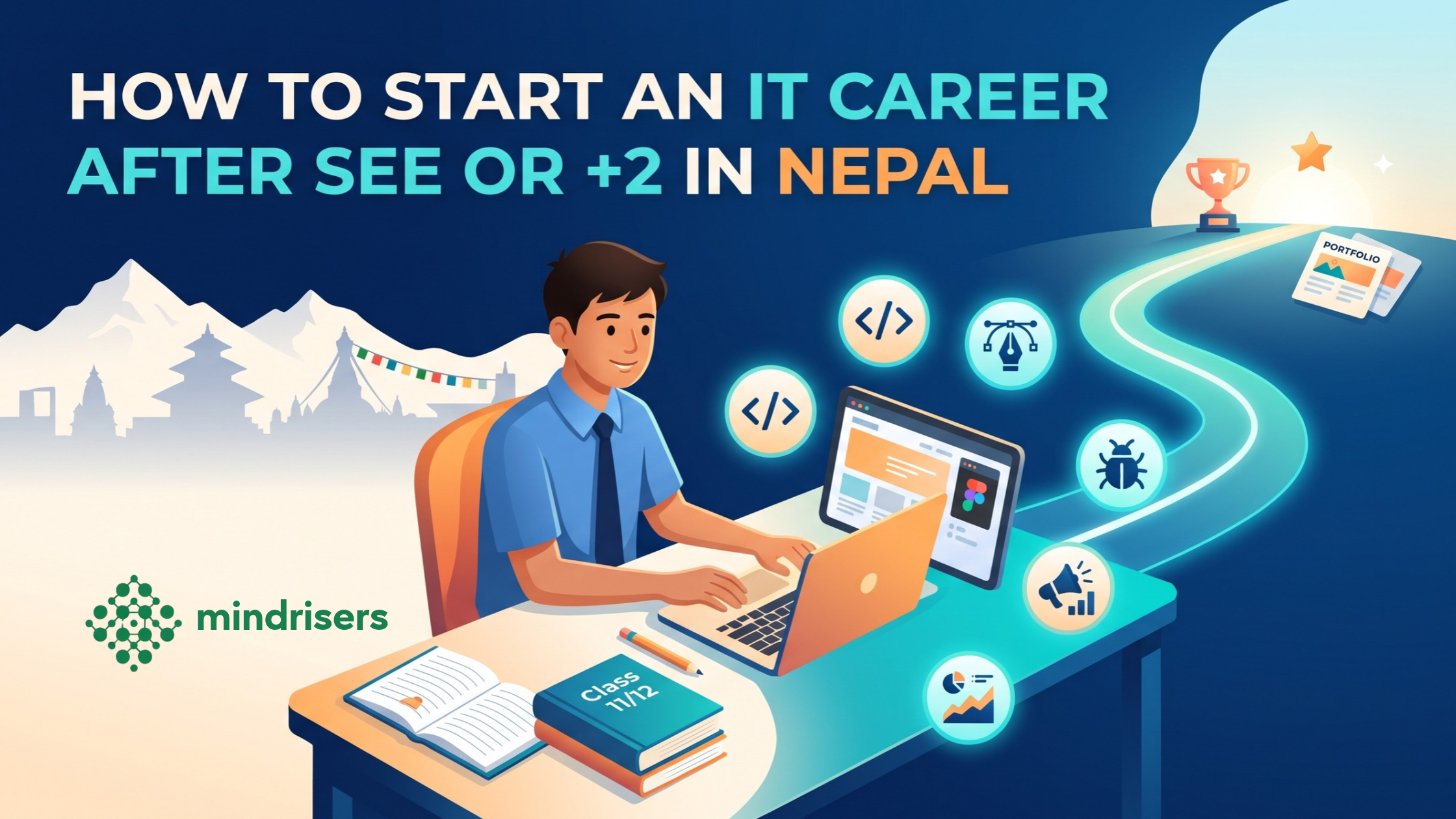
IT Career After SEE and +2 in Nepal: A Practical Guide for Grade 11–12 Students (2027)
2026-11-20.436 Views
Complete Guide: To Starting an IT Career in Nepal Without a Degree
2026-11-18.903 Views
From Classroom Learning to Real-World Experience: My First Step into Digital Marketing
2026-08-24.800 Views

Never miss an Opportunity !
Want to learn TOP 2025 IT Skills ?
We open IT skill classes Monthly in Design, Development, Deployment, Data etc.
Have something to Ask ?
get admission enquiry
