
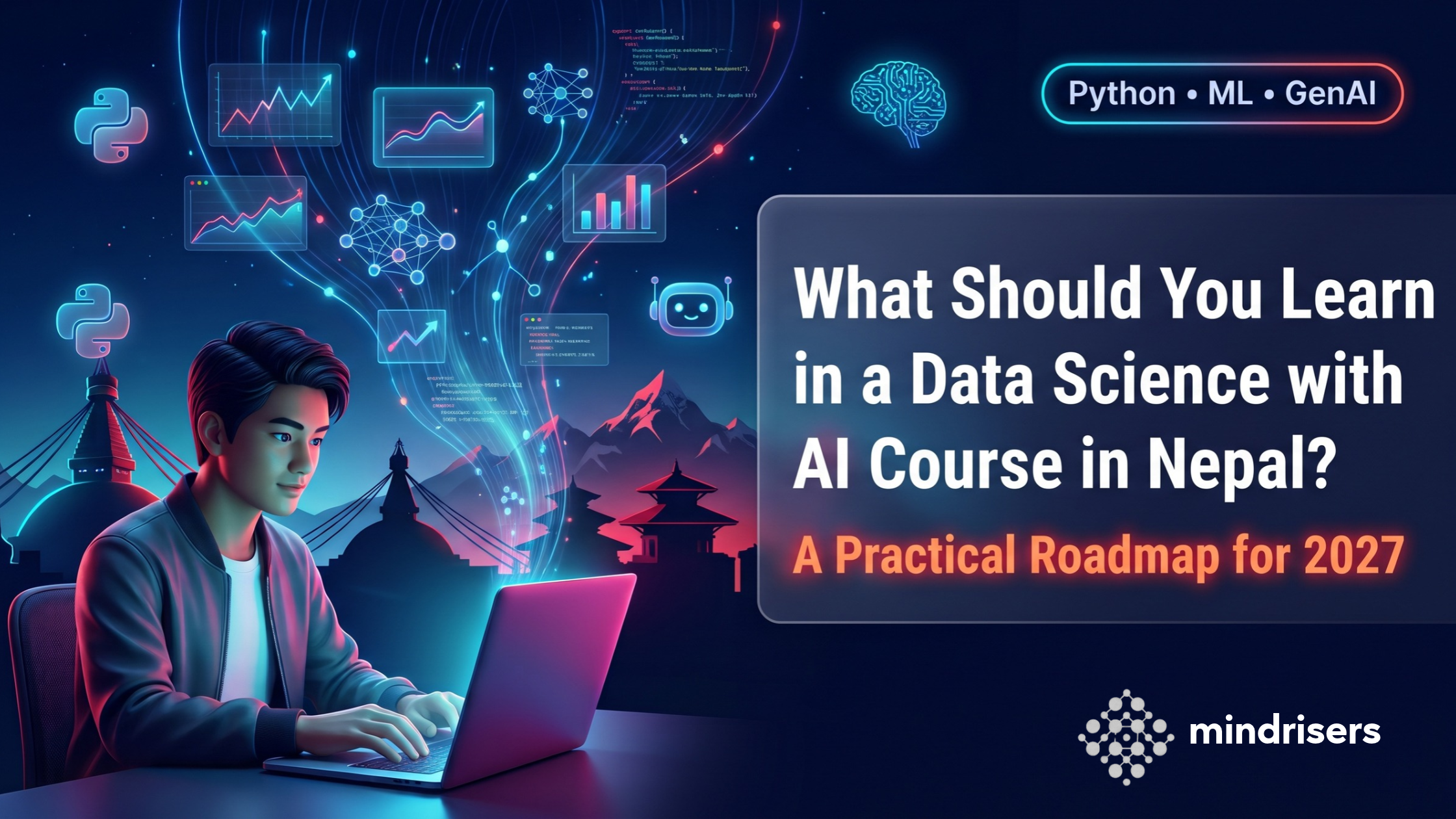
Kevin Joshi - Author
2026-11-24
Every business has data. A shop in Kathmandu has sales records. A bank has transaction patterns. A hospital has appointment histories. A tourism company has seasonal booking trends. But data becomes valuable only when someone can turn it into a reliable answer.
That is what data science is really about.
And in 2027, learning data science means more than knowing a few Python commands or asking an AI chatbot to analyse a spreadsheet. It means understanding the data, choosing the right method, checking whether the result is trustworthy, and turning the result into something people can actually use.
If you are searching for a data science course in Nepal, a data science with AI course in Kathmandu, or a beginner-friendly path into machine learning, this guide explains the skills worth learning and how to judge whether a course prepares you for real work.
Why data science skills matter in the AI era
AI is changing how organisations work, but it does not remove the need for people who understand data. An AI system can generate a chart or suggest a prediction; a skilled practitioner still needs to ask whether the source data is accurate, whether the model has been tested properly, and whether the result makes sense for the business.
The World Economic Forum's Future of Jobs Report 2025 lists AI and big data among the fastest-growing skill areas through 2030. It also reports that 63% of surveyed employers see skills gaps as a major barrier to business transformation. That is a global signal not a guarantee of a particular job in Nepal, but it reinforces the value of building adaptable technical foundations.
There are also practical signals closer to home. Recent Nepal-based ML job descriptions mention Python, SQL, data preparation, model development and monitoring. Some also ask for experience with LLMs, AI agents, model evaluation, APIs and MLOps. The lesson for students is clear: learn the foundations first, then learn how to build and operate AI-enabled solutions.
The seven skills to build
1. Python: learn to work with data, not just write syntax
Python is a practical starting point because it is widely used for data preparation, analysis and machine learning. Begin with variables, data types, conditions, loops, functions, files, exceptions and object-oriented programming. Then learn to use APIs, virtual environments and Git/GitHub.
Your first milestone should be simple: load a dataset, inspect it, clean it and explain what you found. If you cannot explain your code, an AI assistant writing it for you will not solve the problem.
2. Data preparation with NumPy and Pandas
Real datasets are rarely perfect. They may contain missing values, duplicate rows, inconsistent date formats, spelling differences or columns that should not be used together.
Learn how to:
- inspect and clean a dataset;
- handle missing values and duplicates;
- merge and transform tables;
- create useful features;
- document where the data came from.
This is one of the most important practical skills because a sophisticated model trained on poor-quality data can still produce poor results.
3. Statistics and visualisation: know what the numbers mean
A chart is not an explanation. Learn probability, distributions, sampling, confidence intervals, hypothesis testing, correlation and regression. Practise communicating findings with Matplotlib, Seaborn or Plotly.
For example, if a shop's sales increase during a festival, do not immediately claim that a marketing campaign caused the increase. Check the timing, compare relevant periods and consider other explanations. Analytical thinking is what turns a chart into a responsible recommendation.
4. Machine learning: build models and evaluate them honestly
Start with supervised learning, such as regression and classification, then explore unsupervised learning such as clustering. Learn how to split data into training, validation and test sets, use cross-validation, select metrics and check for data leakage.
A model is not good simply because it produces a high score on one dataset. You need to test it on data it has not seen and understand where it fails. Scikit-learn's documentation explains why model evaluation and cross-validation are essential to estimating performance on unseen data.
5. Generative AI: move beyond prompting
Generative AI adds another layer to data work. Learn the basics of large language models, tokens, embeddings and structured outputs. Then understand retrieval-augmented generation (RAG), vector search, function calling, evaluation, hallucination risks and guardrails.
A useful project is a document assistant that answers questions from a defined collection of tourism or policy documents. The system should retrieve relevant source material, show where an answer came from and say when it does not have enough evidence. That is much more meaningful than building a chatbot that simply produces fluent answers.
6. AI agents and production skills
An AI agent can use tools and follow a multi-step workflow, but it still needs boundaries, testing and human oversight. Learn how to design tool use, manage state, evaluate outputs and decide when a person must review the result.
Then learn the engineering that makes a project usable: serving a model through an API, packaging it with Docker, tracking experiments with MLflow, and monitoring performance after deployment. A notebook is a good place to experiment; it is not, by itself, a finished product.
7. Build a portfolio project from beginning to end
A portfolio should prove that you can solve a problem, not just reproduce a tutorial. One Nepal-relevant example is a tourism demand prediction project paired with an AI travel assistant.
A strong version could:
- use a clearly documented, appropriately licensed dataset;
- clean and explore the data;
- build a simple baseline forecast before trying complex models;
- evaluate the model on a held-out period;
- connect a document-based travel assistant using RAG;
- expose the result through an API or simple application;
- document limitations, sources and failure cases.
Other project ideas include retail demand forecasting, customer churn analysis, or sentiment analysis of Nepali-language text. For language projects, document dataset coverage and test performance across different writing styles instead of assuming one score represents every speaker.
What does a good data science course in Nepal look like?
Before enrolling, look beyond a long list of software names. Ask whether the course teaches a complete workflow:
- Does it start with Python, statistics and SQL or data fundamentals?
- Will you clean and analyse imperfect datasets?
- Will you build models and learn how to evaluate them?
- Does it explain GenAI, RAG and responsible use, not only prompt tricks?
- Will you build a project that can be demonstrated?
- Does it cover APIs, deployment and monitoring?
- Will an instructor review your work and explain what needs improvement?
- Is there a clear path to practical workplace experience?
Mindrisers Institute of Technology's published Data Science & ML with GenAI course is listed as a 3.5-month programme at Putalisadak, Kathmandu. Its course page says learners start with Python in week one and lists statistics, NumPy, Pandas, visualisation, machine learning, deep learning, NLP, RAG, AI agents, MLflow, FastAPI, Docker and a Nepal tourism demand prediction plus AI travel assistant capstone. Review the current syllabus and speak with the institute to confirm the latest batch details.
The Mindrisers difference: guaranteed internship for all courses
Learning concepts is important. Applying them in a workplace setting is another step.
Mindrisers highlights a guaranteed internship for students across all its courses. For a student building a data science portfolio, an internship can provide an opportunity to practise professional communication, collaborate on tasks and understand how teams work with real requirements.
Before enrolling, ask the admissions team to explain the internship arrangement in writing including eligibility, timing, duration, supervision, responsibilities and assessment. A guaranteed internship is a meaningful practical-learning benefit, it should not be confused with a guarantee of employment or a particular salary.
Is data science right for you?
You may enjoy data science if you like asking questions, spotting patterns, solving problems and explaining what the evidence means. You do not need to arrive as an expert programmer. You do need curiosity, patience and a willingness to practise consistently.
If you are a +2 graduate exploring technology, a university student building practical skills, or a working professional moving towards data and AI, start by understanding the learning path and the work you want to be able to demonstrate.
The goal is not to collect tool names. The goal is to become someone who can take a real question, work with the data, test an answer and communicate a useful result.
Start building your data science journey with Mindrisers
If you are looking for a practical data science course in Nepal, explore the Data Science & ML with GenAI programme at Mindrisers Institute of Technology, Putalisadak, Kathmandu. Review the syllabus, discuss your goals with the team and ask how the guaranteed internship is arranged.
Your next step in AI should not be another copied prompt. It should be a project you understand, can explain and are proud to show.
Explore the course: Data Science & ML with GenAI
Frequently asked questions
What is a data science with AI course?
A data science with AI course teaches learners to collect, clean and analyse data, apply statistics and machine learning, and use generative AI techniques such as embeddings and RAG to build useful applications. A strong course also teaches model evaluation and deployment.
Can a beginner learn data science in Nepal?
Yes. Beginners can start with Python fundamentals, basic statistics and data handling, then progress to machine learning and AI projects. Mindrisers' published course page says it starts Python in week one and does not require prior programming experience.
Which programming language should I learn first for data science?
Python is a practical first choice because its ecosystem includes tools such as NumPy, Pandas, Matplotlib and scikit-learn. SQL is also important for retrieving and working with data stored in databases.
What is the difference between data science and data analytics?
Data analytics often focuses on examining existing data to explain what happened and support decisions. Data science can include those activities plus statistical modelling, machine learning and predictive systems. In practice, the roles overlap.
How long is Mindrisers' Data Science & ML with GenAI course?
Mindrisers currently lists the programme as 3.5 months. Check the course page or contact the institute to confirm the latest schedule and batch availability.
Does Mindrisers provide an internship?
Mindrisers states that it offers a guaranteed internship for all courses. Contact the institute to confirm the written terms, eligibility, timing, duration and responsibilities for the current batch.
Does a guaranteed internship mean a guaranteed job?
No. An internship and a job are different outcomes. An internship offers practical experience; employment depends on factors such as skills, performance, openings and employer requirements.
What projects should a beginner include in a data science portfolio?
Start with one project that shows data cleaning, exploration, a clear question, a baseline, model evaluation and a written explanation. A second project can demonstrate an AI application with source-grounded answers, documented limitations and a simple deployment.
Recent
- 01What Should You Learn in a Data Science with AI Course in Nepal? A Practical Roadmap for 2027
- 02IT Career After SEE and +2 in Nepal: A Practical Guide for Grade 11–12 Students (2027)
- 03Complete Guide: To Starting an IT Career in Nepal Without a Degree
- 04From Classroom Learning to Real-World Experience: My First Step into Digital Marketing
Recent Post
View All
What Should You Learn in a Data Science with AI Course in Nepal? A Practical Roadmap for 2027
2026-11-24.324 Views
IT Career After SEE and +2 in Nepal: A Practical Guide for Grade 11–12 Students (2027)
2026-11-20.436 Views
Complete Guide: To Starting an IT Career in Nepal Without a Degree
2026-11-18.903 Views
From Classroom Learning to Real-World Experience: My First Step into Digital Marketing
2026-08-24.800 Views

Never miss an Opportunity !
Want to learn TOP 2025 IT Skills ?
We open IT skill classes Monthly in Design, Development, Deployment, Data etc.
Have something to Ask ?
get admission enquiry
