
Astha Chhatri - Author
2026-09-15
A lot of people want to become developers these days. And you go searching for an answer to where to start, and you are overwhelmed by information about HTML, CSS, JavaScript, React, Python, APIs, databases, Node.js, Git, cloud, and AI, etc. Then you come across the challenging question, "Do I pursue Frontend Development, Backend Development, or do I become a Full Stack Developer?" If you are a student or a complete beginner in web development seeking to venture into web development in 2026, it can be quite challenging to pick a path to follow.
You do not need to learn all that overwhelming stuff to become a developer because you will be a genius in whichever path you choose to venture. Frontend, Backend, and Full-stack development are all related, but the main differences lie in the expertise and the challenges developers in these various fields encounter daily. This article aims to explain the three different paths, compare them, highlight the skills required to seek a career in each of the three specializations, and guide you in choosing which way to go.
Frontend vs Backend vs Full Stack: What's the Difference?
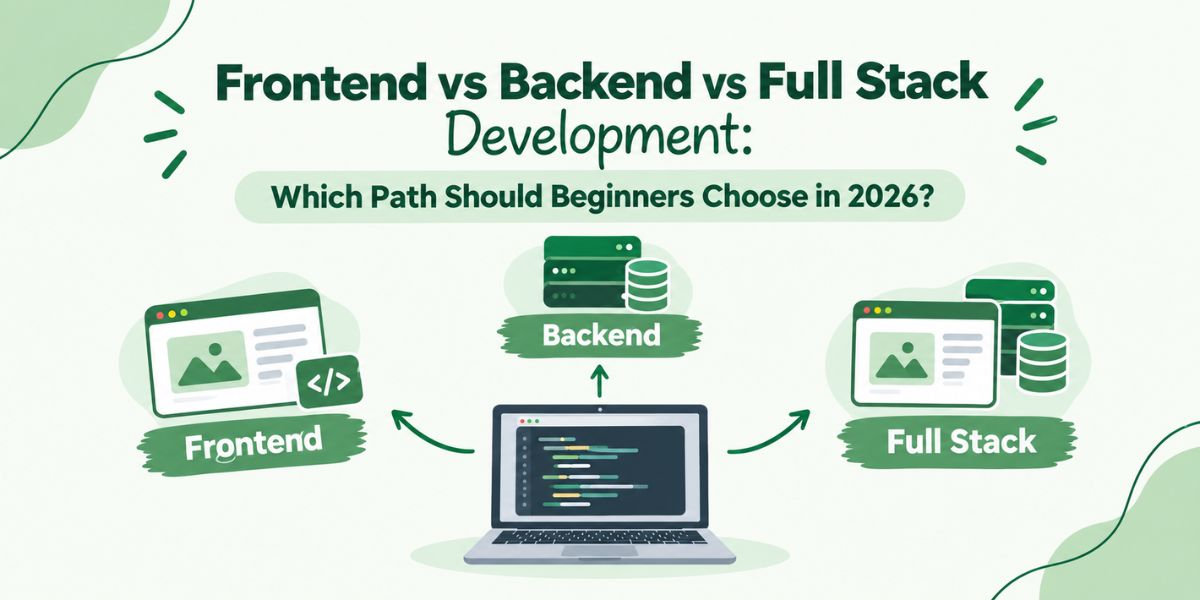
Before choosing the path you want to follow, you need to know what you are going to be doing as a developer. First, think about any website or mobile application that you use daily. The buttons you click, the pictures you see, the menus and forms you fill, all the animation and pages you navigate are what is called the frontend. But when you log in or make a purchase, when you search or do something that makes the application do something, that is the backend.
You can think of a full stack developer as someone that works on both sides, but to put it simply:
• Frontend: what the user sees and interacts with
• Backend: what the user doesn't see but makes the app work
• Full stack: frontend + backend
All three are necessary in any application nowadays.
|
Basis |
Frontend development |
Backend Development |
Fullstack development |
|
Main Focus |
Building the visual and interactive part of a website or application that users see and use. |
Building the server-side logic, databases, APIs, and functionality that power an application. |
Working on both frontend and backend, connecting the user interface with the server and database. |
|
Skills Required |
HTML, CSS, JavaScript, responsive design, UI implementation, and frontend frameworks. |
Server-side programming, databases, APIs, authentication, system logic, and server management. |
Combination of frontend and backend skills, including APIs, databases, UI, server-side logic, and deployment. |
|
Programming language |
HTML, CSS, JavaScript/TypeScript |
Python, Java, PHP, JavaScript/TypeScript, C, etc. |
Usually a combination such as HTML, CSS, JavaScript/TypeScript + Python, Java, PHP, or Node.js. |
|
Typical projects |
Websites, landing pages, dashboards, portfolios, e-commerce interfaces, and web applications. |
APIs, authentication systems, database-driven applications, payment systems, and server-side services. |
Complete web applications such as e-commerce platforms, social media apps, learning platforms, and business systems. |
|
Career Opportunities |
Frontend Developer, UI Developer, Web Developer, React Developer, etc. |
Backend Developer, API Developer, Server-side Developer, Software Developer, etc. |
Full Stack Developer, Full Stack Web Developer, Software Developer, Web Application Developer, etc. |
What Is Frontend Development?
Suppose you are shopping on an online platform searching for items to buy. In that case, you are likely to see images, prices, menus, search bars, buttons, filters, and a shopping cart – all of these are part of the front end of a website. Frontend development is a complex process involving the creation and construction of what people see on the screen and how they interact with it.
Frontend developers use markup language or various coding languages to program web shops, web applications, or web pages. Such developers are also engaged in determining how information on a given page or application is presented and what actions a user can carry out. A frontend developer studies the design or program requirements to determine what transformations need to be made to a website to reflect those changes. For example, specific buttons or images may appear on a website, disappear, or be highlighted when a user purchases an item. This process is triggered by clicking on the “Add to Cart” button, during which the “shopping cart” will have an indication of an item purchased or a pop-up message saying, “Thank you for your purchase.”
What Does a Frontend Developer Work With?
A beginner starts by learning:
• HTML – the language for building webpage’s structure
• CSS – how to lay out and stylize a page, add spacing, responsiveness, etc.
• JavaScript – implements functionality
• Frameworks/Libraries – like React, which allows implementing more complex apps.
The end goal is not just having a pretty website, a frontend developer will make it easy to use and accessible.
What Is Backend Development?
Now imagine what will happen after you click the button 'Login’. You enter your email and password, but the website needs to check if these data are correct. When you place an order, the system needs to save it somehow. When you search for a product, the application needs to somehow find the relevant information. Users may not see these processes, but they are crucial for the application to work. This is where the backend comes into play. The backend is responsible for the server-side logic, databases, APIs, authentication and processes that take place behind the website or application. Backend developers create systems that receive requests from the frontend, process the information, communicate with the database or other services and return an appropriate response to the user.
For example:
You click 'Login' > frontend sends you information > backend checks it > the database is checked > the backend sends a response > the frontend displays the result.
The user may see only 'Login successful', but several processes may have taken place in the background.
What Does a Backend Developer Work With?
Commonly used technologies for the backend development are the following:
• Python
• Java
• PHP
• Node.js
• databases or APIs like MySQL, PostgreSQL
• communication tools for application parts.
Backend development is great for those who like logic, databases, data processing, and working with the underlying system structure.
What Is Full Stack Development?
What if you want to see both sides? That's where full stack development comes in, where a full stack developer acts on both ends of the application. A full-stack developer can design the interface of a program but also build the tools that make this program operate.
Take for example a school registering website. The frontend might have a form such as Name → Date of Birth → Email → Submit. After the students submit their information, something must happen at the back end to receive this data, make sure it's correct, send the information to a database, and reply to the user. A full stack developer can understand both sides of this example, but being a full stack developer doesn't mean you know all languages and tools available. It just means you know enough to build, operate, design, and debug an application at hand. This trait is what draws many new developers and the draw of full-stack development is its ability to have this wide spectrum of knowledge at one’s disposal.
Frontend vs Backend vs Full Stack: The Real Difference
The easiest way to explain the difference is to think about a restaurant. Frontend is what the customer sees. The menu, tables, food presentation, ordering interface, overall customer experience etc. Backend is the kitchen, inventory, processes, order management, staff coordination, and other things that happen in the kitchen that the customer usually doesn't see. Full stack is when you know what goes on both inside and outside the kitchen. A website works in much the same way. Frontend is what the customer sees. The backend is the processes that happen to make the website work. Full stack connects an understanding of both.
Which One Should a Beginner Choose?
There is no universal path to development; the most common question is “What type of issues do I want to solve?” If you like design, interaction with visuals, creating, and getting instant satisfaction, then perhaps you should start with frontend development. If you like logic, databases, programming, data, and solving hidden issues, maybe you should begin with backend development. If you want to learn how the whole application works from the user’s screen to the data stored in the database, full stack development is the way to go! One vital thing that many beginners forget is that their first choice does not have to be definitive; you can always change it. You do not have to forever stick to front-end development if you start with it, and the same goes for the other two paths. Development is not a place where you enter and remain forever bound by the first task you undertook.
The Most Important Thing to Understand Before Choosing
Do not choose a path just because you heard that it has the "highest salary", is "easiest", or "most popular".
Technology changes. Tools change. Frameworks change. Requirements change.
What is valuable to you is having an:
• Understanding of the programming fundamentals,
• Logical thinking,
• Problem solving,
• Building things,
• Understanding applications,
• and learning new technologies when necessary.
Choosing the Right Field of Your Interest
The choice of Frontend, Backend, or Full Stack Development as your career field should not be a hard one. Each of these areas is great for beginners. The best among them is the one that suits your interests, learning pattern, and the problems you wish to solve while developing applications.
If you love designing and working on visual elements and interactive interfaces, you may want to start with Frontend Development. Those interested in programming languages and databases have a clear image of pursuing Backend Development. However, if you want to have a comprehensive understanding of the processes that take place during application development and have a vision of the overall picture, choose Full Stack. Remember that in each of these three fields, you will find yourself in a constant process of learning and upgrading. It may also benefit you to analyze the pros and cons of switching from one area to another.
Most importantly, do not feel like you must stick to one branch of development for your entire career. You can start your journey from one of these fields, practice, and then switch to another one. Having basic knowledge of one area can also benefit you while you are learning another. As a result, you will find it less challenging to become a full-stack developer.
If you are interested in acquiring practical knowledge and want to invest in your future IT career, check out Mindrisers Institute of Technology. Our courses are designed to provide you with the necessary conceptual and practical understanding of the selected field. You will get qualified assistance from our team of professionals, learn the basics of programming, and gain relevant technical skills. Thus, you will prepare yourself for a productive career in the IT field.
Recent
- 01Frontend vs Backend vs Full Stack Development: Which Path Should Beginners Choose in 2026?
- 02Data Science Course in Nepal: Skills, Career Opportunities and Future Scope in 2026
- 03From Classroom Learning to Real-World Experience: My First Step into Digital Marketing
- 04Inside Mindrisers Cybersecurity Course: Modules, Tools & Career Paths Explained
Recent Post
View All
Frontend vs Backend vs Full Stack Development: Which Path Should Beginners Choose in 2026?
2026-09-15.305 Views
Data Science Course in Nepal: Skills, Career Opportunities and Future Scope in 2026
2026-09-07.378 Views
From Classroom Learning to Real-World Experience: My First Step into Digital Marketing
2026-08-24.449 Views
Inside Mindrisers Cybersecurity Course: Modules, Tools & Career Paths Explained
2026-08-13.498 Views

Never miss an Opportunity !
Want to learn TOP 2025 IT Skills ?
We open IT skill classes Monthly in Design, Development, Deployment, Data etc.
Have something to Ask ?
get admission enquiry