
Kevin Joshi - Author
2025-12-02
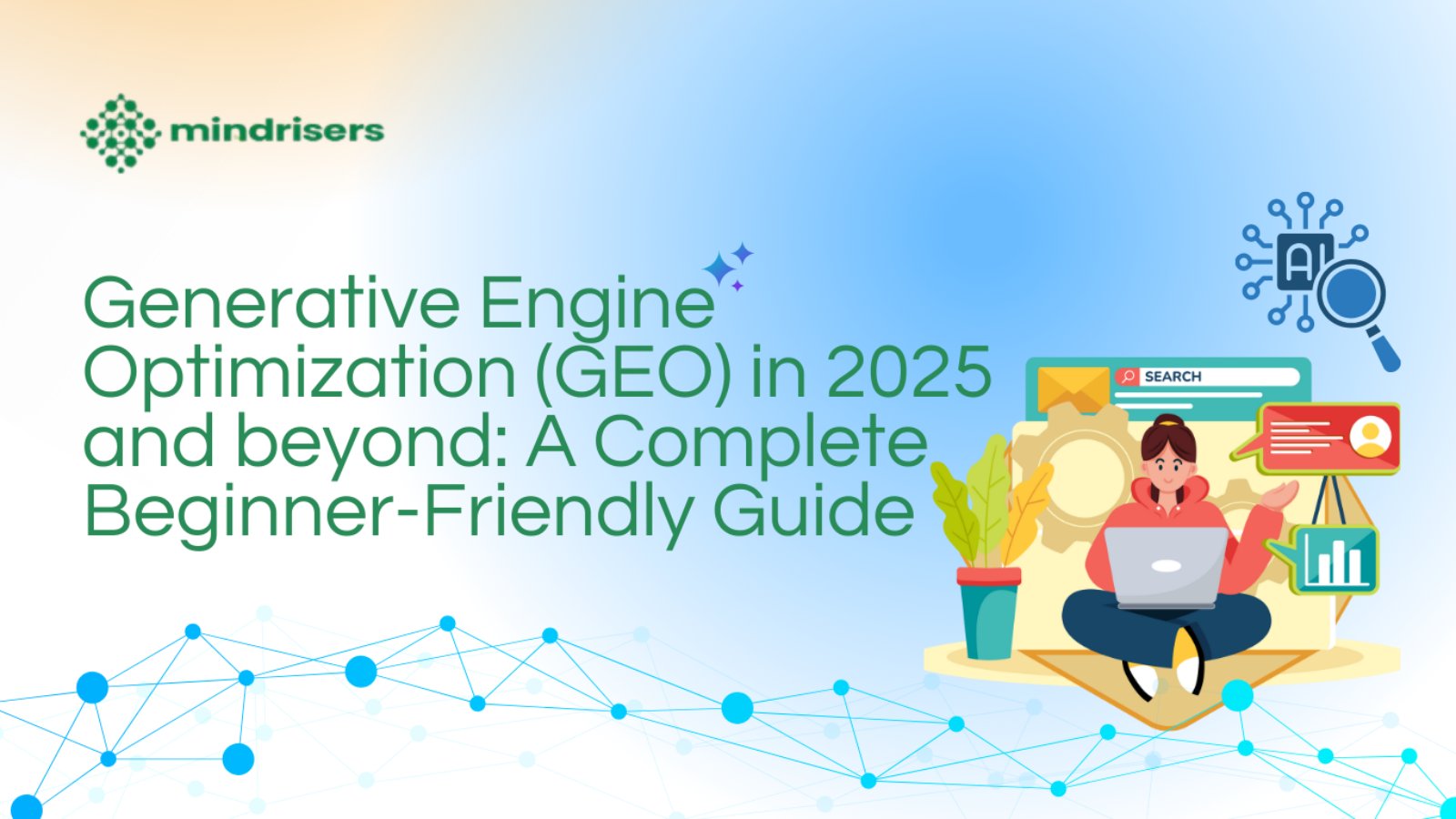
Search is changing faster than ever before. Not long ago, people typed a question into Google and clicked through several links to find their answer. But in 2025 and onwards, users often skip this process. They now ask AI engines like ChatGPT, Gemini, Perplexity, and Claude to give them direct, ready-made answers as per the user request.
These generative engines do not simply show a list of websites. They produce full explanations, summaries, and recommendations. This shift has created an entirely new form of visibility for brands and content creators.
This new field is called Generative Engine Optimization (GEO). If you want your business or website to appear inside AI-generated answers, this guide will show you everything you need to know, with clear steps and easy-to-understand concepts.
What Is Generative Engine Optimization?
Generative Engine Optimization, or GEO, is the process of making your content easy for AI engines to understand, trust, and use when they create their answers. Traditional SEO helps your website show up on search engine results pages. GEO does something different. It helps your information show up inside AI conversations and summaries.
When someone asks a question to an AI tool, the engine gathers information from across the internet. It chooses content that is reliable, well-structured, factual, and easy to read. If your content meets these standards, the AI tool is more likely to include your brand or website in its answer.
GEO focuses on four goals:
1. Answering real user questions,
2. Writing in a clear structure,
3. Showing expertise and credibility,
4. Making your website technically understandable to AI systems.
These goals help your content get discovered by generative engines in the same way SEO helps it get discovered by search engines.
Why GEO Exists in 2025 and its future
Generative engines are becoming an important part of everyday search behavior. People are no longer only reading search results. They depend on AI tools for summaries, instructions, recommendations, and research. Because of this shift, brands need to be visible not only on Google but also within the responses created by AI.
This shift means that businesses cannot rely on SEO alone. They must also understand how AI models read, evaluate, and choose content. GEO gives brands a way to adapt to this new world.
How Generative Engine Optimization Works
Generative Engine Optimization works by improving the clarity, trustworthiness, and structure of your content so that AI engines can understand it. Although GEO is newer than SEO, the process is simpler than it seems. Here are the key stages that explain how GEO works.
1. AI Identifies User Intent
When a person asks a question, AI tools look at what the user is actually trying to understand. This is called user intent. Unlike search engines, which match keywords, AI tools analyze meaning. They look for content that answers real questions clearly and directly.
This is why GEO focuses heavily on understanding the types of questions people ask. When your content matches those questions, it becomes more valuable to the engine.
2. AI Looks for Clear and Structured Content
AI models process information differently from humans. They need simple structure, clean formatting, and clear explanations. They also need content that can be summarized without losing accuracy. This includes short sentences, direct answers, and organized paragraphs.
Well-structured content helps the AI engine decide what parts are important. If your content is confused, unclear, or filled with unnecessary details, the engine may ignore it.
3. AI Checks for Accuracy, Authority, and Trust
GEO requires strong trust signals. These signals show that your content is reliable. AI tools prefer sources that show expertise, experience, authority, and trustworthiness. These are the same principles used in EEAT standards.
What's EEAT Standard?
E-E-A-T stands for Experience, Expertise, Authoritativeness, and Trustworthiness, which are Google's quality standards for evaluating content.
Content that cites accurate data, uses reputable sources, and is written by knowledgeable authors ranks higher in the world of generative engines. If your content is vague or unsupported, AI is less likely to include it in its responses.
4. AI Connects Content Through Technical Signals
Technical GEO involves using structured data, schema markup, and clean website architecture. These tools help AI engines understand what your website is about and how your content is connected.
When your site uses schema correctly, generative engines can more easily extract information such as definitions, lists, FAQs, product features, and professional details. The more machine-readable your site is, the stronger your GEO performance becomes.
GEO vs. SEO in 2025: How Are They Different?
Many people think GEO is the next version of SEO. That is not correct. GEO does not replace SEO. Instead, it works alongside SEO. They serve different roles in your brand's digital visibility.
Here is a clear comparison of the two:
Focus
SEO focuses on optimizing your content for search engine results pages. GEO focuses on optimizing content for AI-generated responses.
Ranking vs. Mentioning
SEO aims to get your content ranked on Google, Bing, or other search engines. GEO aims to get your brand mentioned inside an AI model’s answer.
Keywords vs. Prompts
SEO is based on keywords and search habits. GEO is based on prompts, questions, and conversational intent.
Trust Signals
SEO depends heavily on backlinks and site authority. GEO depends more on content accuracy, credibility, sourcing, and trust.
User Behavior
SEO follows traditional click-based search behavior. GEO follows modern conversational search behavior used in AI tools.
In simple terms, SEO wins clicks. GEO wins citations. Both matter in 2025 because users search in both ways.
Benefits of Using GEO for Your Business
Generative Engine Optimization helps you get ahead in a world where AI engines are taking over the search experience. Here are the benefits of doing GEO well.
Increased Visibility in AI Answers
When AI engines pull information to answer user questions, your brand is more likely to appear if your content is GEO-optimized.
Stronger Brand Authority
Because GEO prioritizes trust and factual accuracy, it naturally strengthens your brand’s authority in your field.
Better Alignment With How People Search Today
People now rely on conversational AI, not just search engines. GEO helps your content match this new behavior.
Future-Proof Growth
Search patterns will continue to change in the next decade. GEO prepares your website for future technologies and reduces overdependence on traditional SEO.
How To Do GEO for Your Website
Here is a simple and practical guide to implementing GEO on your site.
1. Start With Prompt and Question Research
Instead of only researching keywords, research the types of questions people ask AI engines about your industry. Open a tool like ChatGPT or Perplexity and search your topic. Look at the structure of their answers and the questions users ask.
Make a list of:
- Frequently asked questions
- Common instructions users need
- Typical misunderstandings
- Step-by-step guides people request
These insights help you design content that matches user intent.
2. Write Clear, Direct, and Trustworthy Content
Your writing should be easy to understand. Use shorter sentences, clear headings, and clean paragraphs. Explain ideas in a simple and factual way. Avoid overly complex words or confusing structure.
AI engines prefer content that is:
- Easy to summarize
- Straightforward
- Accurate
- Supported with evidence
3. Add Authority and Trust Signals
Demonstrate your expertise. Cite reliable sources. Use original data, case studies, personal experience, and clear reasoning. Use author bios and transparent publishing standards.
These signals show AI engines that your content is reliable and worth citing.
4. Use Structured Data and Schema
Add schema for articles, FAQs, products, services, reviews, and local business data. Structured data makes your content easier for AI models to process.
5. Keep Your Website Technically Clean
Make sure your site loads fast, uses clear navigation, and avoids duplicate content. Remove outdated or misleading information. AI engines prefer websites with strong technical quality.
Why GEO and SEO Should Work Together
Using GEO alone is not enough. SEO is still essential for ranking in search engines, especially for users who prefer traditional search. When GEO and SEO work together, you cover both environments: AI conversations and search engine results pages.
A strong GEO strategy builds trust and authority, while a strong SEO strategy builds traffic and visibility. Together, they create a complete digital marketing strategy.
Learn GEO, SEO, AI Prompting, and Digital Marketing at Mindrisers
To succeed in the new digital world, you need skills that match changing technology. Mindrisers offers a complete 360-degree digital marketing course where you can learn SEO, GEO, AI prompting, content strategy, social media marketing, and more. Mindrisers prepares students to understand both traditional search and modern AI-driven visibility.
If you want a career that adapts to the future and stays ahead of the trend, studying at Mindrisers is one of the best steps you can take. Our training covers real projects, practical skills, and industry-ready knowledge.
Recent
- 01How GPT, Perplexity, and AI Overviews Are Changing SEO Careers
- 02Frontend vs Backend vs Full Stack Development: Which Path Should Beginners Choose in 2026?
- 03Data Science Course in Nepal: Skills, Career Opportunities and Future Scope in 2026
- 04From Classroom Learning to Real-World Experience: My First Step into Digital Marketing
Recent Post
View All
How GPT, Perplexity, and AI Overviews Are Changing SEO Careers
2026-09-24.305 Views
Frontend vs Backend vs Full Stack Development: Which Path Should Beginners Choose in 2026?
2026-09-15.376 Views
Data Science Course in Nepal: Skills, Career Opportunities and Future Scope in 2026
2026-09-07.424 Views
From Classroom Learning to Real-World Experience: My First Step into Digital Marketing
2026-08-24.502 Views

Never miss an Opportunity !
Want to learn TOP 2025 IT Skills ?
We open IT skill classes Monthly in Design, Development, Deployment, Data etc.
Have something to Ask ?
get admission enquiry